Introduction
Anyone who has stood in a crowded kitchen aisle, trying to decide between a slow cooker, a rice cooker, a steamer basket, and a pressure cooker, understands the appeal of a single appliance that tries to do it all. The Instant Pot Pro (8 Qt) 10-in-1 sits squarely in that category. It’s marketed as a multi-cooker capable of handling pressure cooking, slow cooking, sautéing, steaming, rice and grain preparation, yogurt making, sterilizing, warming, and sous vide cooking — all from one countertop unit, controlled through a digital panel and paired with a companion recipe app.
This article walks through what the appliance actually offers, how people commonly put it to use, who tends to get the most value from it, and a few practical considerations worth thinking through before adding one more appliance to your kitchen. The goal here isn’t to convince you it’s the right choice — it’s to give you enough grounded, accurate information to decide that for yourself.
Key Features
Ten Cooking Functions in One Housing
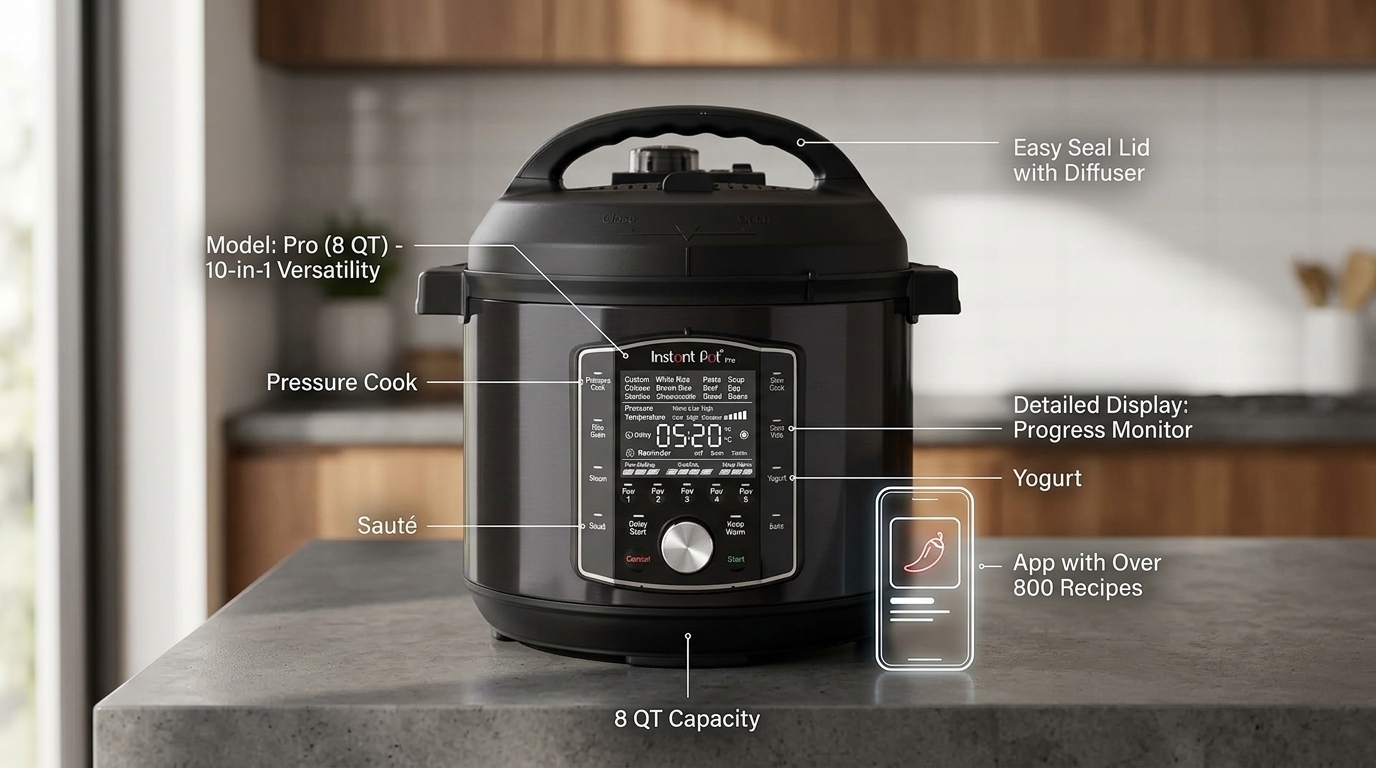
The core pitch of this model is consolidation. Instead of owning a dedicated pressure cooker, a separate slow cooker, a rice cooker, a steamer, and a sauté pan, the idea is that one appliance handles all of those roles. According to the manufacturer’s listing, the unit supports pressure cooking, slow cooking, sautéing, steaming, rice and grain cooking, yogurt making, sterilizing, warming, and sous vide cooking. Each mode is accessed through preset buttons on the control panel, so switching from, say, a pressure-cooked stew to a warming setting doesn’t require pulling out a different appliance — just selecting a different program on the same base unit.
It’s worth noting that “10-in-1” branding on kitchen appliances is common shorthand for the range of cooking modes and preset categories available, rather than ten entirely separate physical mechanisms. In practical terms, that means most of these functions share the same heating element, inner pot, and lid system, with software and preset timing doing the work of adapting the appliance to each task.
Smart Programs and One-Touch Presets
Beyond the core cooking modes, the appliance includes a set of roughly two dozen customizable one-touch programs, along with a handful of “favorites” slots that let you save your own frequently used settings for quicker access later. This is meant to reduce some of the guesswork that came with earlier pressure cooker models, where users had to manually calculate pressure levels and cook times for specific dishes like rice, beans, or yogurt.
Power and Cooking Speed
The unit runs on a 1400-watt heating element, which is on the higher end for countertop multi-cookers in this size range. Instant Pot’s own marketing describes preheating as roughly 20% faster and overall cooking as up to 70% faster compared to traditional slow-cooking methods — figures that come from the manufacturer rather than independent lab testing, so it’s reasonable to treat them as a general directional claim rather than a guaranteed result in every recipe.
An 8-Quart, Family-Oriented Capacity
This particular version comes in the 8-quart size, which the manufacturer positions as suitable for roughly eight servings. That capacity tends to work well for larger households, batch cooking, or anyone who likes to cook once and eat across several days. It’s a noticeably larger footprint than the 6-quart versions of similar Instant Pot models, so it’s worth measuring your available counter and cabinet space before purchasing, since the larger capacity does come with a larger physical unit.
Steam Release and Safety Mechanisms
The lid includes a steam release switch paired with a diffusing cover, designed to let steam escape more gradually and with less noise than older pressure cooker designs. On the safety side, the listing describes an auto-sealing safety lid lock, overheat protection, and easy-grip handles on the inner pot. These are standard expectations for modern electric pressure cookers, but they’re worth mentioning because early generations of pressure cookers (the old stovetop kind) didn’t have this level of built-in mechanical safeguarding, and some buyers coming from those older tools appreciate the added reassurance.
Stainless Steel Inner Pot and Cleanup
The inner cooking pot is stainless steel rather than a non-stick coated pot, which tends to hold up better over years of use and is generally considered safer for browning and searing at higher temperatures during the sauté function. Both the lid and inner pot are described as dishwasher-safe, which simplifies cleanup after use, though hand-washing is still often recommended for the sealing ring to help it last longer and avoid retaining odors from strongly flavored dishes.
Companion App and Recipe Access
The listing includes access to a companion recipe app featuring over 800 recipes. This is primarily a recipe and guidance resource — step-by-step instructions, ingredient lists, and suggested settings for a wide range of dishes. It’s worth flagging that some Instant Pot models in the broader lineup (particularly ones branded “Pro Plus” or “Smart WiFi”) include full wireless remote control, letting you start, stop, or monitor cooking from your phone. Whether that level of remote connectivity is included with this specific model can vary by version and region, so if app-based remote control matters to you specifically, it’s worth double-checking the current product listing rather than assuming it’s included.
Included Accessories
The appliance typically ships with an extra sealing ring and a stainless-steel steamer basket with handles, which is a practical inclusion for anyone planning to use the steaming function for vegetables, dumplings, or fish without buying separate accessories right away.
How It Can Be Used
One of the more interesting things about a multi-cooker like this is how differently people end up using it depending on their household and cooking habits. Here are some of the more common use cases:
Weeknight batch cooking. Because the pressure cooking function can dramatically cut down cook times for things like beans, grains, stews, and tougher cuts of meat, a lot of people use it to prepare larger batches of a base recipe — chili, pulled pork, lentil soup — that can be portioned out and eaten across several days or frozen for later.
Slow cooking for hands-off meals. The slow cook function turns the same base unit into something closer to a traditional slow cooker, useful for dishes that benefit from long, low-temperature cooking, like pot roasts or braised dishes, without requiring a separate slow cooker appliance taking up cabinet space.
Rice and grains. The rice/grain cooker setting is designed to simplify cooking rice, quinoa, and similar grains with more consistent results than stovetop methods, which can be handy for households that eat rice frequently and want a “set it and walk away” option.
Steaming vegetables, dumplings, or seafood. Using the included steamer basket, the unit can steam vegetables or proteins without submerging them directly in liquid, which is useful for preserving texture and nutrients compared to boiling.
Sautéing before pressure cooking. The sauté function allows browning meat or softening aromatics like onions and garlic directly in the same pot before switching to pressure cooking or slow cooking, which cuts down on the number of dishes used for a single recipe.
Yogurt making. The yogurt setting maintains a consistent low temperature over an extended period, which is the key requirement for culturing yogurt at home, an option that some buyers specifically look for compared to standard pressure cookers that lack this mode.
Sterilizing. The sterilize function is often used for baby bottles, jars, and other items that need a heat-based sterilization cycle, which can be a nice bonus feature for households with infants or anyone doing home canning or fermenting projects that require sterile equipment.
Sous vide cooking. The sous vide setting allows for precise, lower-temperature water bath cooking, often used for proteins like steak or eggs where consistent doneness is the goal. It’s worth noting that multi-cooker sous vide functions like this one typically work by heating and holding water temperature within the pot itself, rather than using a separate circulating immersion wand the way dedicated sous vide equipment does. That distinction can matter if you’re particular about circulation for very precise, professional-style sous vide results.
Keeping food warm for gatherings. The warm setting is a practical option for potlucks, holiday meals, or any situation where food needs to stay at serving temperature for an extended period without continuing to cook.
Who It May Be Suitable For
Given the feature set, certain types of cooks and households tend to get more consistent use out of an appliance like this:
- Larger households or people who cook for groups. The 8-quart capacity is sized for bigger batches, so it tends to make more sense for families, meal preppers, or anyone who regularly hosts.
- People consolidating kitchen appliances. If counter space or cabinet storage is limited, replacing several single-purpose appliances with one multi-function unit can be appealing, even if each individual function isn’t quite as specialized as a dedicated device.
- Home cooks newer to pressure cooking. The combination of preset programs and a companion recipe app can lower the learning curve compared to older stovetop pressure cookers that require more manual calculation.
- Households with specific needs like yogurt-making or bottle sterilizing. These are less common built-in functions, so if you specifically want them, this style of appliance can save you from buying separate single-purpose gadgets.
On the other hand, this may not be the ideal fit for:
- People living alone or in very small households, where a 6-quart or smaller appliance might be more proportionate to typical portion sizes and easier to store.
- Anyone who specifically wants air-frying capability. This particular model does not include an air fryer function — that’s a separate line within the Instant Pot family (sometimes labeled “Crisp” or “Duo Crisp”), so if crispy, air-fried textures are a priority, it’s worth comparing that specific model instead.
- Cooks who want a dedicated, highly specialized tool for one task, such as a professional-grade sous vide circulator or a high-end rice cooker built purely around rice texture — a multi-function appliance is generally a trade-off between convenience and specialization.
Important Things to Consider
No appliance is a perfect fit for every kitchen, and it’s worth thinking through a few practical points before deciding.
Counter and storage space. An 8-quart multi-cooker is a substantial appliance — noticeably larger and heavier than 6-quart versions. If your kitchen has limited counter real estate or you plan to store it in a cabinet between uses, it’s worth checking the exact dimensions and weight listed on the current product page to make sure it fits comfortably in your space.
Learning curve for pressure cooking. Even with presets and an app, pressure cooking is a different experience than boiling or stovetop cooking, particularly around timing, natural versus quick pressure release, and liquid ratios. New users often find it helpful to start with simple, well-tested recipes before adapting their own favorite dishes to a pressure cooker format.
Sealing ring maintenance. Silicone sealing rings can absorb odors from strongly flavored or spiced dishes over time. Many users choose to keep a second ring on hand (often included with this appliance) — one dedicated to savory cooking and another for sweeter dishes like yogurt or desserts — to avoid cross-contamination of flavors.
App and connectivity expectations. As mentioned earlier, it’s worth confirming exactly what level of app functionality is included with this specific model — recipe access versus full wireless remote control — since Instant Pot’s product lineup includes multiple tiers with different connectivity features, and listings can be updated over time.
Altitude and recipe adjustments. Pressure cooking times can be affected by altitude, and while many recipes and apps account for this, it’s a detail worth being aware of if you live at a significantly higher elevation.
Warranty and manufacturer support. As with any electric kitchen appliance, checking the current warranty terms and manufacturer support policies through the official listing or manufacturer site is a reasonable step before purchase, since these details can change and are best confirmed at the time of buying rather than assumed.
Comparison of General Categories
It can help to zoom out and compare the general category this appliance belongs to against other common kitchen appliance approaches, without getting into brand-versus-brand comparisons.
| Category | General Description | Typical Strengths | Typical Trade-offs |
|---|---|---|---|
| Single-purpose appliances (e.g., a standalone rice cooker or slow cooker) | One appliance built around one specific cooking method | Often simpler to operate, may be optimized for one result | Requires more appliances overall, more storage and counter space needed |
| Basic multi-cookers | Combine a handful of functions (commonly pressure cook, slow cook, sauté, steam) in one unit with manual or preset controls | Space-saving, generally lower learning curve, budget-conscious | Fewer specialized functions, no app or smart connectivity |
| Full-featured multi-cookers (this general category) | Combine many functions — including less common ones like sous vide, yogurt, and sterilizing — plus a companion recipe app | Broad versatility, reduces the number of separate appliances needed, guided recipes can help beginners | Larger and heavier unit, some functions may be less specialized than dedicated equipment, learning curve for less familiar functions |
| Smart, WiFi-connected multi-cookers | Similar function range to full-featured multi-cookers, with added remote monitoring and control through an app | Convenience of starting or checking on cooking remotely | Typically a higher price point, dependent on stable WiFi and app performance |
Where a given model sits in this landscape depends on which functions, capacity, and connectivity features matter most to your household. There isn’t a universally “better” category — it comes down to how much you value consolidation and convenience versus specialization and simplicity.
Frequently Asked Questions
Does this appliance replace the need for a separate rice cooker or slow cooker? For many households, yes — the built-in rice/grain and slow cook functions are designed to cover those use cases. Whether the results match what you’d get from a dedicated single-purpose appliance can depend on personal preference and the specific dish, since dedicated appliances are sometimes fine-tuned for one job.
Is the sous vide function the same as a dedicated immersion circulator? Not exactly. This type of built-in sous vide function generally heats and holds water temperature within the pot itself, rather than using a separate circulating wand. It can still work well for many sous vide recipes, but it’s a different mechanism than dedicated sous vide equipment.
Does the app allow remote control of the appliance over WiFi? The app is primarily a recipe and guidance resource. Full wireless remote control (starting, stopping, or monitoring cooking from your phone) is a feature associated with certain WiFi-connected models in the broader product lineup. It’s worth checking the current listing to confirm exactly what connectivity features are included with this specific version.
Can the inner pot and lid go in the dishwasher? According to the manufacturer’s listing, both the lid and inner pot are dishwasher-safe. The sealing ring is often better hand-washed to help it last longer.
Is this appliance suitable for a small household or single person? It can be used by a single person, but the 8-quart capacity is generally geared toward larger batches. Smaller households sometimes prefer a 6-quart version if counter space or portion sizes are a bigger priority than batch cooking.
Does it include an air fryer function? No. This particular 10-in-1 model does not include air frying or crisping. Instant Pot offers separate models specifically designed with an air fryer function if that’s a feature you’re looking for.
What accessories come included? The listing typically includes an extra sealing ring and a stainless-steel steamer basket with handles, in addition to the main unit and lid.
How many one-touch programs does it offer? The appliance includes roughly two dozen customizable smart programs, along with several “favorite” slots for saving your own frequently used settings.
Conclusion
The Instant Pot Pro (8 Qt) 10-in-1 is, at its core, an attempt to fold a wide range of common kitchen appliances into a single countertop unit — pressure cooker, slow cooker, rice cooker, steamer, sauté pan, yogurt maker, sterilizer, warmer, and a sous vide-style water bath, all controlled through one panel and supported by a recipe app. For households that value consolidation, batch cooking, and a moderate learning curve compared to older-style pressure cookers, it’s a reasonable option to look into. For those who want a highly specialized tool for one specific job, or who need air-frying capability, it may be worth comparing against more specialized appliances or other models within the same product family.
As with most kitchen equipment purchases, the right fit really depends on your household size, how you currently cook, and how much counter and storage space you’re working with. It’s worth reviewing the current listing details — including exact dimensions, included accessories, and app features — since specifics can be updated over time.