Introduction
Anyone who has tried to cook for a large household, a holiday gathering, or a weekend of meal prep knows that pot size matters just as much as the recipe itself. A slow cooker that’s too small forces you to cook in batches, while one that’s oddly shaped can make it hard to fit a roast or a whole chicken. The Crock-Pot 7-Quart Manual Slow Cooker was designed with exactly this problem in mind — it’s built for families, gatherings, and anyone who regularly cooks in bulk.
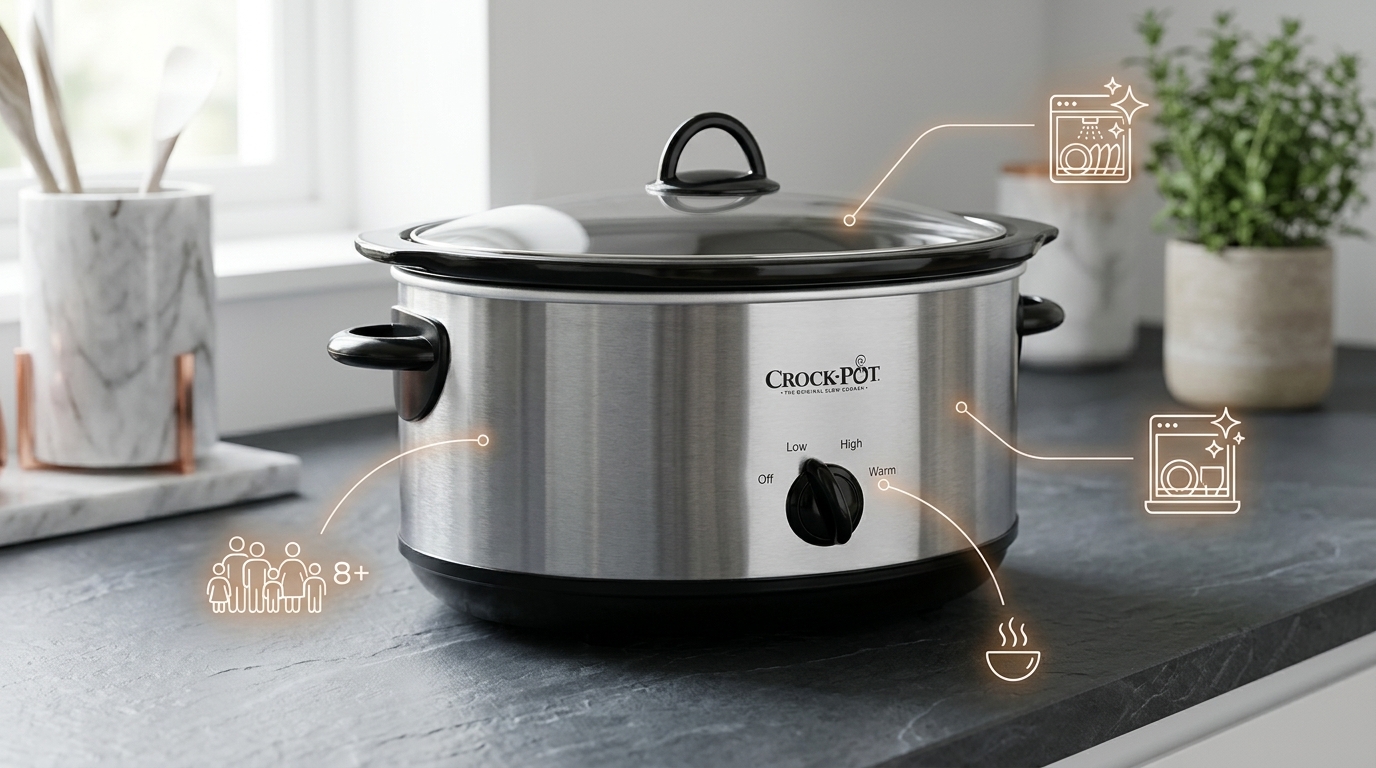
This particular model sits in the “family size” category of slow cookers, with an oval stoneware insert rated to serve eight or more people and to accommodate a roast of up to six pounds. It uses a straightforward manual dial system rather than digital programming, which appeals to people who prefer simple, tactile kitchen tools over screens and buttons. The stainless steel exterior with black accents gives it a clean, countertop-friendly look, and the removable stoneware and glass lid are dishwasher safe, which cuts down on post-meal cleanup.
In this article, we’ll walk through what this slow cooker offers, how people commonly put it to use, who tends to find it useful, and what’s worth thinking about before adding one to your kitchen. The goal here isn’t to tell you it’s the “best” anything — it’s to give you a clear, balanced picture so you can decide whether it fits your own cooking habits and household size.
Key Features
7-Quart Capacity Built for Larger Households
At the core of this appliance is its 7-quart oval stoneware crock. That’s a substantial jump from the compact 1.5- to 4-quart cookers often marketed for singles or couples, and even a step up from the mid-range 5- to 6-quart models common in many kitchens. A 7-quart capacity is generally large enough to prepare a meal for eight or more people in one batch, or to fit a roast weighing up to around six pounds — think a whole chicken, a pork shoulder, or a beef roast with room left for vegetables and broth.
Manual HIGH / LOW / WARM Controls
Rather than a digital interface with programmable timers, this model uses a simple manual dial with three settings: HIGH, LOW, and WARM. HIGH is generally used for shorter cook times when you want food ready in a few hours, LOW is suited to longer, slower cooking sessions (often used for all-day cooking while at work), and WARM is intended to hold finished food at a safe serving temperature without continuing to cook it. This kind of manual control tends to appeal to cooks who prefer a no-frills, easy-to-understand appliance without extra electronic features to learn.
Removable, Dishwasher-Safe Stoneware and Lid
The oval stoneware insert lifts out of the housing, which makes it much easier to serve directly from the pot, transport food to another room, or clean up afterward. Both the stoneware crock and the glass lid are labeled dishwasher safe, so there’s no need to hand-wash the largest components after a big meal — a detail that matters more than it might sound like when you’ve just cooked for a crowd.
Stainless Steel Exterior with Cool-Touch Handles
The outer housing is finished in stainless steel with black accents, giving it a neutral look that tends to blend with most kitchen color schemes. The side handles are made of heat-resistant plastic, designed to stay cooler to the touch than the metal body during and after cooking, which makes it easier to move the unit safely once you’re done.
Compact Footprint for Its Size
Even though the capacity is generous, the unit is designed with a relatively manageable footprint for countertop or storage use. Reported dimensions for this style of 7-quart Crock-Pot are roughly 16.8–16.9 inches in length, 11.8 inches in width, and about 10.3–10.4 inches in height, with a cord length of around 24 inches. That’s worth keeping in mind if counter or cabinet space is limited in your kitchen.

How It Can Be Used
A 7-quart manual slow cooker like this one tends to get the most use in households that either cook in bulk regularly or host gatherings a few times a year. Here are some of the more common ways people put a slow cooker of this size to work.
Whole roasts and larger cuts of meat. Because the stoneware is rated to fit a roast up to about six pounds, it’s well suited to slow-cooking a pork shoulder for pulled pork, a whole chicken, a beef brisket, or a pot roast with root vegetables. The oval shape in particular is designed to accommodate longer cuts of meat more naturally than a round crock would.
Soups, stews, and chilis in large batches. A big stockpot of chili, beef stew, or vegetable soup can easily fill a 7-quart crock, which makes this size a natural fit for anyone who likes to cook once and eat (or freeze) for several days afterward.
Holiday side dishes and potluck contributions. Slow cookers are frequently used to free up stovetop and oven space during holidays. Mashed potatoes, baked beans, mac and cheese, or stuffing can all be prepared in advance and then held on the WARM setting, which is particularly useful when oven space is already committed to a turkey or ham.
Batch cooking and meal prep. For people who prepare meals in advance for the week, a larger capacity means fewer cooking sessions. A single batch of shredded chicken, pulled pork, or a big pot of beans can be portioned out and refrigerated or frozen for multiple meals.
Entertaining and keeping food at serving temperature. The WARM setting is designed to hold cooked food at a safe temperature for a period of time without continuing to cook it further, which can be useful when guests arrive at staggered times or when food needs to sit out during a longer gathering.
Freezer-to-slow-cooker style meals. Many people prepare freezer bags of raw ingredients — meat, vegetables, and seasoning — ahead of time, then dump the contents into the crock on a busy morning. A larger capacity crock accommodates these bulkier freezer meal portions more easily than a smaller cooker would.
Who It May Be Suitable For
Given its size and manual operation, this slow cooker tends to appeal to a fairly specific set of households and cooking habits, rather than being a universal fit for every kitchen.
Larger families and multi-person households. For homes with four or more regular eaters, a 7-quart capacity often means you can prepare a full meal in one session rather than cooking twice or supplementing with a second dish.
People who host regularly. If you find yourself cooking for extended family, holiday gatherings, or potlucks more than a few times a year, having a slow cooker sized for eight-plus servings can reduce the need to borrow or improvise extra cookware.
Meal preppers and batch cooks. Anyone who prefers to cook large quantities on the weekend and portion meals out for the week may find the extra capacity useful, since it reduces the number of cooking cycles needed.
Cooks who prefer simplicity over programmability. Because this is a manual model rather than a programmable one, it may suit people who don’t want to deal with digital timers, delayed-start settings, or app connectivity, and who are comfortable checking on food or setting a separate kitchen timer themselves.
Budget-conscious buyers. Manual slow cookers are generally simpler in construction than their programmable counterparts, since they don’t include electronic timer boards or digital displays. This can make them a practical option for people who want a large-capacity cooker without paying for programmable features they may not use.
On the other hand, this may be less suitable for individuals or couples cooking primarily single portions, for kitchens with very limited counter or storage space, or for people who specifically want programmable features like delayed start times or automatic countdown timers.
Important Things to Consider
No kitchen appliance is a perfect fit for every situation, and it’s worth thinking through a few practical details before deciding whether this size and style of slow cooker matches your needs.
No digital timer or automatic shutoff by time. Because this is a manual model, it doesn’t include a programmable countdown timer that automatically switches to WARM after a set number of hours the way some digital slow cookers do. Cooks who want that “set it and forget it for exactly six hours” style of automation may want to compare this against programmable models before deciding.
Storage and counter space. A 7-quart appliance is noticeably larger than a standard 4- to 6-quart slow cooker. Before purchasing, it’s worth measuring your available cabinet or counter space, particularly if your kitchen storage is limited.
Stoneware weight and care. Ceramic stoneware inserts, while sturdy for everyday cooking, can be heavier than metal inserts and are generally more susceptible to cracking if dropped or exposed to sudden temperature changes (for example, adding cold liquid to a very hot crock, or placing a hot crock directly onto a cold surface). Following the manufacturer’s care instructions can help extend its lifespan.
Sizing for smaller households. If you typically cook for one or two people, a 7-quart capacity may be more than necessary for everyday use, and a smaller-capacity slow cooker might be more practical for portion control and storage.
Manual monitoring. Since there’s no digital delay-start or precise timer, some cooks prefer to plan meals around when they’ll be home to switch the setting from HIGH or LOW to WARM, or to use a separate kitchen timer or reminder as a workaround.
Cord length and outlet placement. With a cord of roughly 24 inches, it’s worth considering where your kitchen outlets are relative to where you plan to place the unit, especially if your counter layout requires a longer reach.
Comparing General Categories of Slow Cookers
Rather than comparing this specific model against individual competing products, it can be more useful to understand the broader categories of slow cookers on the market, so you can see where this style fits into the bigger picture.
Manual vs. Programmable Slow Cookers. Manual slow cookers, like the one discussed in this article, rely on a simple dial with HIGH, LOW, and WARM settings. They tend to be straightforward to operate and often come at a more accessible price point due to simpler internal components. Programmable slow cookers, by contrast, include digital displays that allow users to set specific cook times, and many will automatically switch to a warming mode once the timer runs out. Programmable models can offer more precision and hands-off convenience, but they also introduce more electronics that could eventually need troubleshooting or replacement.
Capacity Classes. Slow cookers are generally grouped into a few broad size categories: compact (1.5–3 quarts, often used for dips, sauces, or single servings), mid-size (4–6 quarts, suited to small-to-medium families), and large or “family size” (7 quarts and above, designed for bigger households, batch cooking, or entertaining). Choosing the right category typically comes down to household size and how often you cook in bulk, rather than one size being universally better than another.
Stoneware Inserts vs. Metal Inserts. Most traditional slow cookers, including this one, use a ceramic stoneware insert, which is prized for even heat distribution and is generally considered good for classic slow-cooked dishes like stews and roasts. Some multi-cookers or pressure-cooker hybrids instead use metal inserts, which tend to be lighter and more resistant to cracking, but which some cooks feel distribute heat differently than ceramic.
Single-Function vs. Multi-Function Appliances. A dedicated slow cooker like this one is built to do one thing — slow cook — without additional functions like sautéing, pressure cooking, or air frying. Multi-function cookers can consolidate several appliances into one unit, which may appeal to those short on kitchen space, but they can also come with a steeper learning curve and, in some cases, a higher price point for the added functionality.
Understanding these general categories can help clarify that the “right” slow cooker often depends less on brand and more on matching capacity, control style, and insert material to your own cooking habits.
Frequently Asked Questions
Does this slow cooker have an automatic shutoff or timer? This is a manual model, which means it does not include a programmable countdown timer. It operates on HIGH, LOW, and WARM settings, and switching between them is done manually rather than automatically after a set number of hours.
How many people can this slow cooker realistically feed? The 7-quart capacity is generally described as suitable for serving eight or more people, depending on the recipe and portion sizes. It’s also sized to fit a roast of up to approximately six pounds.
Is the stoneware insert removable? Yes, the oval stoneware crock is designed to be removable from the outer housing, which makes it easier to serve food directly at the table and to clean the components separately.
Can the stoneware and lid go in the dishwasher? According to product specifications, both the removable stoneware insert and the glass lid are labeled dishwasher safe. As with most kitchenware, hand-washing is also an option if preferred.
What’s the difference between the HIGH, LOW, and WARM settings? Generally speaking, HIGH is used for faster cooking over a shorter window, LOW is used for extended, slower cooking (often over many hours), and WARM is intended to hold already-cooked food at a safe serving temperature without continuing to actively cook it. Specific cooking times will vary by recipe.
Is this slow cooker oven-safe? Manufacturer guidance should always be checked directly, as care and usage instructions can vary by model and are typically included in the product manual or on the manufacturer’s website. It’s a good habit to review those details before attempting to use any slow cooker component outside of its intended appliance.
How much space does it take up? Reported dimensions for this style of 7-quart model are approximately 16.8 to 16.9 inches in length, 11.8 inches in width, and roughly 10.3 to 10.4 inches in height. It’s worth measuring your available counter or storage space against these figures before purchasing.
Is a manual slow cooker harder to use than a programmable one? Not necessarily — many people find manual dials easier to understand at a glance, since there’s no digital menu to navigate. The main trade-off is that a manual model won’t automatically switch to WARM after a preset cook time the way some programmable models do, so a bit more attention to timing may be needed.
Conclusion
The Crock-Pot 7-Quart Manual Slow Cooker is, at its core, a large-capacity, no-frills appliance built around a simple idea: make it easy to cook a big meal with minimal fuss and minimal cleanup. Its oval stoneware insert, sized for roasts up to six pounds and meals for eight or more people, positions it well for larger households, regular entertaining, and batch cooking, while its manual HIGH/LOW/WARM dial keeps the learning curve low for anyone who’d rather not deal with digital programming.
Like any kitchen appliance, it comes with trade-offs worth weighing — namely the lack of an automatic timer and the extra counter or storage space a 7-quart unit requires. Whether it’s the right fit ultimately comes down to how often you cook for a crowd, how much space you have to store it, and whether you prefer manual controls over programmable ones.