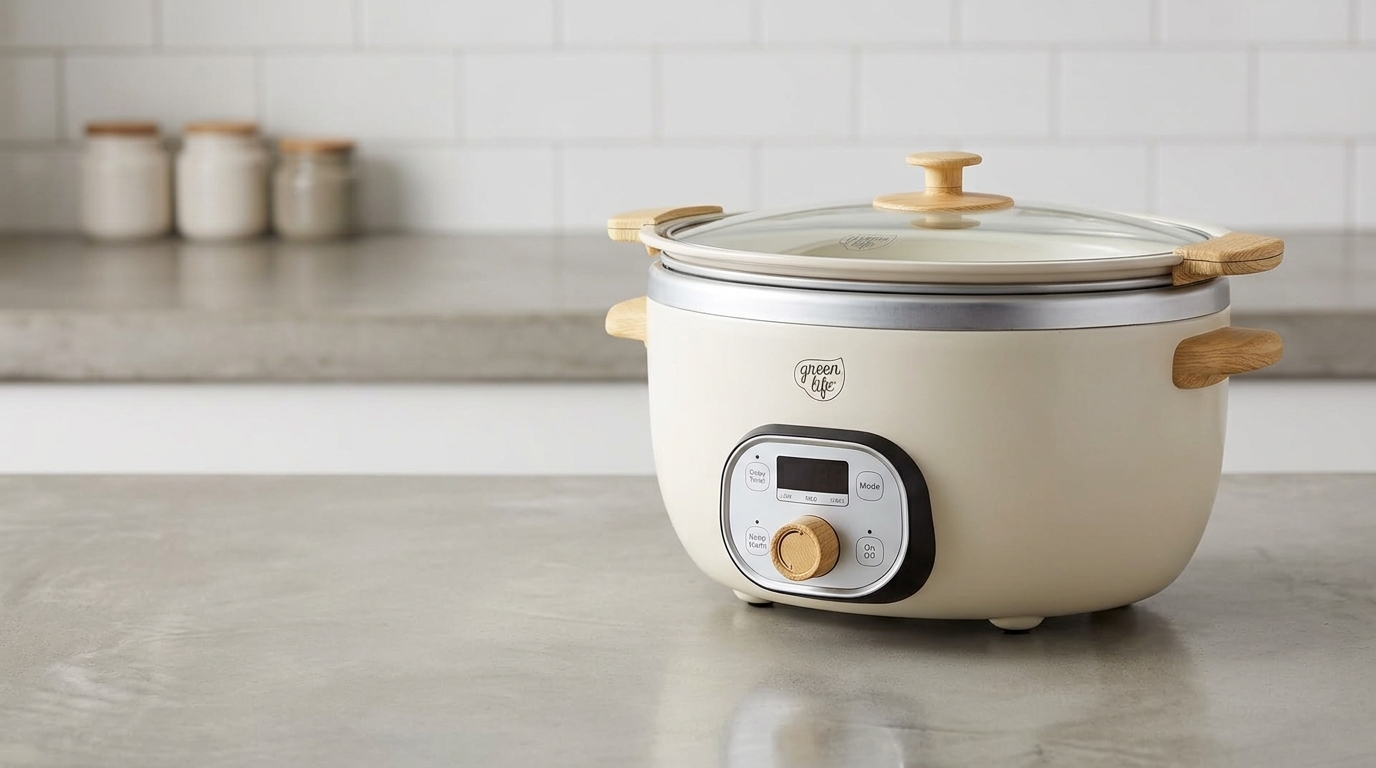
Slow cookers have earned a permanent spot on many kitchen counters, largely because they solve a very specific problem: turning tougher, less expensive cuts of meat and hearty vegetables into tender, flavorful meals with minimal hands-on effort. Within that crowded appliance category, GreenLife’s 6QT Ceramic Nonstick Slow Cooker in Cream stands out for one particular reason — its inner pot isn’t limited to the slow cooker base. It’s designed to move between the stovetop, the oven, and the cooking base, which changes how a slow cooker can actually be used in a real kitchen routine.
This article takes a closer look at what this appliance offers, how people commonly put it to use, who tends to get the most value from it, and a few practical details worth keeping in mind before adding one to your kitchen lineup. The goal here isn’t to tell you it’s the “best” anything — it’s to walk through the facts so you can decide whether it fits the way you actually cook.
Key Features
Ceramic Nonstick Interior
The inner pot uses a ceramic nonstick coating that GreenLife describes as being derived from sand rather than traditional PTFE-based nonstick chemistry. According to the manufacturer, the coating is formulated without PFAS, PFOA, lead, or cadmium. For anyone who has spent time researching cookware materials, this kind of labeling has become increasingly common as brands respond to consumer interest in reducing exposure to certain synthetic coatings. It’s worth noting that “PFAS-free” refers specifically to the nonstick surface chemistry and isn’t a guarantee about every material used in the appliance’s construction, such as the base, cord, or electrical components.
In everyday terms, a ceramic nonstick surface generally means food is less likely to bond to the bottom of the pot during long cook times, which in turn tends to make post-meal cleanup less of a chore compared to a fully unglazed or rougher-textured surface.
Stovetop- and Oven-Safe Removable Pot
This is arguably the feature that separates this model from a typical basic slow cooker. Most conventional slow cookers use a stoneware or ceramic insert that is only rated for use inside the appliance’s heating base — placing that insert directly on a gas or electric burner would usually damage it or void the warranty. GreenLife’s inner pot, by contrast, is built to be removable and safe to use directly on the stovetop, as well as in a conventional oven.
Practically, this means the same vessel that browns meat on the stove can then be set into the slow cooker base to continue cooking low and slow, without dirtying a separate skillet or transferring food between containers. It also opens the door to using the pot as a stand-alone oven-safe dish for tasks unrelated to slow cooking, such as baking a casserole. As with any cookware, it’s a good idea to check the specific maximum temperature rating listed in the product manual before placing it under a broiler or at very high oven temperatures, since these limits vary between models and materials.
Programmable Control Panel
The control panel includes a small set of functions designed to keep operation straightforward: three heat modes (low, medium, and high), a keep-warm setting, a delay timer, and an on/off control. According to the manufacturer’s listed specifications, the unit can run anywhere from about 30 minutes up to 20 hours of active cooking, the timer can be programmed up to 10 hours in advance, and the keep-warm function automatically engages for up to 4 hours once cooking finishes.
This kind of programmability is fairly standard in mid-range slow cookers today, but it remains a meaningful upgrade over older manual dial models that require someone to physically switch the setting or unplug the unit once food is done. Being able to set a delay timer in the morning and come home to a finished, warm meal is one of the more practical conveniences built into this design.
Capacity and Design
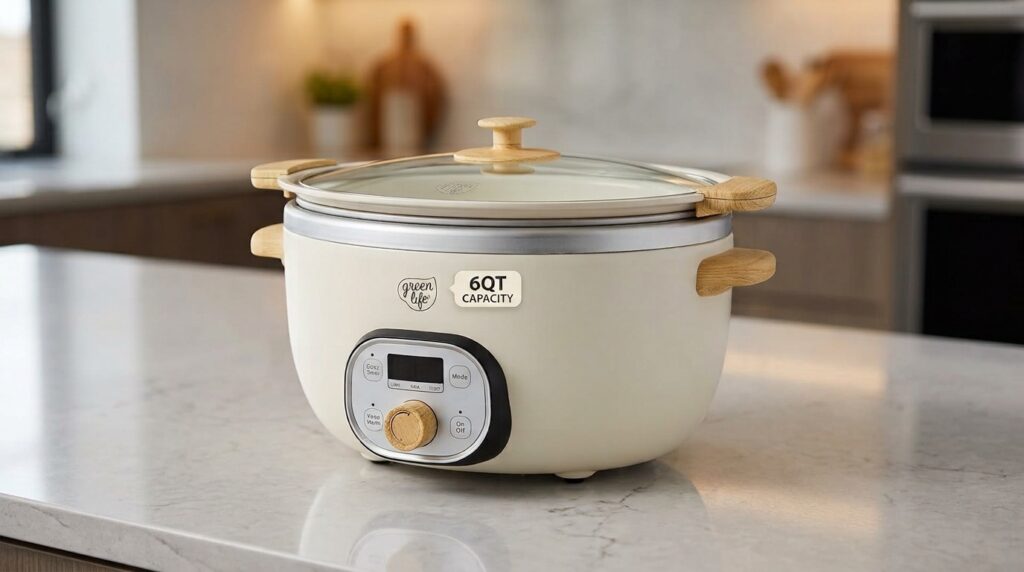
At 6 quarts, this model falls into the “family-sized” range of slow cookers. GreenLife notes that the pot can accommodate roughly a 6-pound chicken or a 4-pound roast, with enough total volume to serve around 6 to 7 people depending on the recipe and how much liquid or additional ingredients are included. That capacity generally makes it suitable for a household of four or more, for people who like to batch-cook and freeze portions, or for anyone who regularly hosts.
The Cream colorway gives it a neutral, fairly understated look that tends to blend into most kitchen color schemes rather than standing out as a bold accent piece. GreenLife also offers this same model in other finishes, along with smaller (3.5QT) and larger (8QT) capacity options, for anyone whose household size doesn’t quite match the 6-quart range.
Dishwasher-Safe Components
The lid and the removable inner pot are listed as dishwasher safe, which is a meaningful convenience given how often slow cookers are used for meals that involve sauces, marinades, or sticky glazes that can be tedious to hand-wash. The heating base itself — like nearly all electric slow cooker bases — is not submersible and should be wiped down separately rather than placed in a dishwasher or run under water.
How It Can Be Used
A slow cooker’s core function is straightforward: low, steady heat applied over an extended period, which works well for breaking down connective tissue in tougher cuts of meat and melding flavors in soups, stews, and braises. But the added stovetop-and-oven flexibility of this particular model opens up a few additional ways it can fit into a cooking routine.
Sear-then-slow-cook meals. Recipes that call for browning meat before slow cooking — a step that adds noticeable depth of flavor through caramelization — usually require dirtying a separate pan first. With a stovetop-safe pot, that browning step can happen directly in the same vessel that goes on to slow cook the rest of the meal, cutting down on extra dishes.
Batch cooking and meal prep. The 6-quart capacity lends itself well to preparing larger quantities of chili, pulled pork, shredded chicken, bean dishes, or grain-based casseroles that can be portioned out and refrigerated or frozen for the week ahead. The delay timer and keep-warm function are particularly useful here, since a batch can be started before leaving for work and will be ready — and held at a safe serving temperature — by the time someone gets home.
Everyday weeknight meals. Classic slow cooker staples like pot roast, soups, chicken and rice dishes, and vegetable-forward stews remain the most common use case. The programmable timer means a meal can be started in the morning without requiring someone to be home to switch it to warm at the right moment.
Entertaining and potlucks. Because the pot maintains a warm holding temperature for a few hours after cooking finishes, it can double as a serving vessel for gatherings, buffets, or potluck contributions, keeping food at a reasonable temperature without needing a separate warming tray.
Oven-based dishes outside of slow cooking. Since the pot itself is oven safe, it can also be used on its own — separate from the electric base — for baked casseroles, cobblers, or other dishes that call for an oven-safe ceramic vessel with some depth.
Who It May Be Suitable For
This slow cooker tends to be a good match for a fairly specific set of kitchen needs, though of course individual preferences vary.
- Families or households of four or more who regularly cook meals in larger batches will likely find the 6-quart capacity a comfortable fit, especially for whole poultry, roasts, or family-style stews.
- People who meal prep for the week ahead may appreciate the combination of a generous capacity, a programmable timer, and an automatic keep-warm function that reduces the risk of overcooking food left unattended.
- Home cooks who prefer fewer dishes and want to minimize the number of pots and pans used for a single recipe may find real value in the stovetop-to-slow-cooker workflow, since it removes a separate searing step.
- Anyone specifically looking to avoid PTFE-based nonstick coatings in favor of a ceramic-based alternative may find this appliance aligns with that preference, keeping in mind that ceramic nonstick coatings have their own care requirements (more on that below).
- People furnishing a kitchen with a cohesive, neutral color palette may appreciate the Cream finish, which tends to read as more understated than brighter colorways.
On the other hand, single-person households, those with very limited kitchen storage space, or people who almost exclusively cook small-portion meals may find a 6-quart appliance larger than what they typically need — GreenLife’s smaller 3.5QT version, or another compact slow cooker, might be a more proportionate choice in that case.
Important Things to Consider
No kitchen appliance is a perfect fit for every household, and there are a handful of practical details worth thinking through before purchasing.
Ceramic nonstick coatings require gentler care than metal utensils allow. Even though the pot is described as tough enough for stovetop and oven use, ceramic nonstick surfaces generally last longer when used with silicone, wood, or plastic utensils rather than metal ones, which can scratch the coating over time and gradually reduce its nonstick performance.
Confirm the specific maximum oven temperature before broiling or baking at high heat. Manufacturers typically list a maximum safe oven temperature for nonstick cookware, and exceeding it — or using the broiler — can degrade certain nonstick coatings faster than standard baking. It’s worth checking the included manual or the product listing for GreenLife’s specific temperature guidance rather than assuming it matches other cookware you may already own.
The heating base is not dishwasher safe or submersible. Only the lid and inner pot go in the dishwasher; the electrical base needs to be unplugged and wiped down with a damp cloth, which is a routine but easy detail to overlook.
Six quarts is a genuinely large appliance. Between the pot, lid, and base, a 6-quart slow cooker takes up a fair amount of counter or cabinet space. It’s worth measuring available storage before buying, particularly in smaller kitchens.
Cream-colored finishes can show certain stains more visibly than darker colors. Tomato-based sauces or turmeric-heavy dishes, for instance, may leave more visible marks on a light-colored exterior over time compared to black or darker finishes, even though the interior cooking surface itself is nonstick and easy to wipe down.
Programmable features vary by model and generation. GreenLife sells multiple versions of this slow cooker across different sizes and colorways, and small feature differences (such as exact timer increments or the number of functions) can vary between listings. It’s a good habit to double-check the specifications on the exact listing you’re considering rather than assuming every version is identical.
Comparison of General Categories
Rather than comparing this specific model against other individual products, it can be more useful to understand where it sits among the broader categories of slow cookers generally available on the market.
Ceramic nonstick pots vs. traditional glazed stoneware. Most classic slow cookers use a glazed stoneware or ceramic insert that is not designed for stovetop use and is typically heavier and more brittle to sudden temperature changes. Ceramic nonstick pots, like the one in this model, are generally lighter, more resistant to food sticking, and — when specifically rated for it — safer to move between the stovetop, oven, and slow cooker base. The tradeoff is that nonstick coatings of any kind, including ceramic-based ones, tend to have a finite lifespan and typically need to be replaced eventually, whereas plain glazed stoneware, while heavier and more prone to sticking, can often last for many years without any coating degradation.
Stovetop-compatible pots vs. base-only inserts. Slow cookers with inserts limited to the base (the more common design) require a separate pan for browning ingredients, adding a dish to the cleanup process but often at a lower price point. Models with stovetop- and oven-safe pots, like this one, reduce dishwashing and cooking steps but are sometimes priced a bit higher to reflect the added material engineering required for a pot that can handle direct flame or burner heat.
Programmable digital controls vs. manual dial controls. Basic slow cookers often use a simple three-position dial (low, high, warm) with no timer, requiring someone to manually switch settings. Programmable models add a delay timer and automatic keep-warm transition, which is more convenient for hands-off cooking but does add a small amount of electronic complexity that isn’t present in fully manual designs.
Family-sized (6–8 quart) vs. compact (1.5–4 quart) capacities. Larger slow cookers are better suited to bigger households, batch cooking, and whole roasts or poultry, while compact models are more efficient for singles, couples, or side-dish-sized recipes like dips and small grain dishes. Choosing between them mostly comes down to typical serving size rather than one category being inherently better than the other.
None of these categories is universally superior — the right choice really depends on kitchen space, typical batch size, cooking habits, and how much someone values the ability to sear and slow-cook in the same vessel.
Frequently Asked Questions
Is the inner pot safe to use directly on a gas stovetop? According to GreenLife’s product information, the pot is designed to be stovetop safe, which allows it to be used for searing or browning before transferring it to the slow cooker base. As with any cookware, it’s sensible to follow the manufacturer’s specific instructions regarding compatible stovetop types and heat levels.
Can the pot go in the oven, and up to what temperature? The pot is described as oven safe. Because maximum oven temperature ratings can vary between specific product versions, it’s best to check the temperature limit listed in the included manual or on the current product listing before using it in the oven, particularly at higher temperatures.
Does this model have a timer, or does it need to be manually switched off? It includes a programmable delay timer that can be set up to 10 hours in advance, along with an automatic keep-warm function that engages for up to 4 hours after the cooking cycle ends, reducing the need to manually monitor or switch the appliance.
Is the entire appliance dishwasher safe? Only the lid and the removable inner pot are dishwasher safe. The electric heating base should not be submerged in water or placed in a dishwasher; it should be unplugged and wiped clean with a damp cloth instead.
What size household is a 6-quart slow cooker generally appropriate for? A 6-quart capacity is typically considered family-sized, generally comfortable for households of four or more, or for anyone who regularly batch-cooks or wants leftovers. Smaller households or those who mainly cook individual portions might find a compact model more proportionate to their needs.
Is the ceramic nonstick coating the same as traditional Teflon-style nonstick coatings? No. GreenLife describes its ceramic nonstick coating as being derived from sand and formulated without PFAS, PFOA, lead, or cadmium, which differentiates it from traditional PTFE-based nonstick coatings. Ceramic nonstick surfaces still benefit from gentle care, such as avoiding metal utensils, to help preserve their nonstick properties over time.
Does this slow cooker come in other sizes or colors? Yes. GreenLife offers this general design across a range of capacities, including smaller (3.5QT) and larger (8QT) options, as well as multiple color finishes beyond Cream, so it’s possible to match capacity and aesthetic preferences to a specific household’s needs.
How long can food safely stay on the keep-warm setting? The keep-warm function is listed as running for up to 4 hours after the cooking cycle completes. For food safety, it’s generally good practice to follow standard guidance on how long cooked food should sit at warm holding temperatures before it’s refrigerated or served, particularly for dishes containing meat, dairy, or eggs.
Conclusion
The GreenLife 6QT Ceramic Nonstick Slow Cooker in Cream is, at its core, a family-sized appliance built around a fairly simple idea: reduce the number of pots involved in a slow-cooked meal by making the inner vessel usable on the stovetop and in the oven, not just inside the slow cooker base. Combined with a PFAS-free ceramic nonstick coating, dishwasher-safe components, and a programmable control panel with a delay timer and keep-warm function, it’s designed to fit into a fairly standard weeknight cooking routine, batch-prep sessions, or casual entertaining.
Whether it’s the right choice ultimately depends on your household size, how much you value stovetop-to-slow-cooker versatility, and your personal preferences around cookware materials and kitchen aesthetics. Reviewing the full specifications, current pricing, and customer feedback directly on the product page is a reasonable next step for anyone weighing this option against other slow cookers.