Introduction
Kitchen appliances have been trending smaller for years now, and it’s not hard to see why. Between shrinking apartment counters, more people living alone or as couples, and a general shift toward cooking smaller portions more intentionally, the “family-size” slow cooker that dominated countertops in the 1990s isn’t always the right tool for the job anymore. Sometimes you just need to simmer a single portion of chili, keep a small batch of queso warm during a get-together, or slow-cook a couple of chicken thighs without heating up an oven.
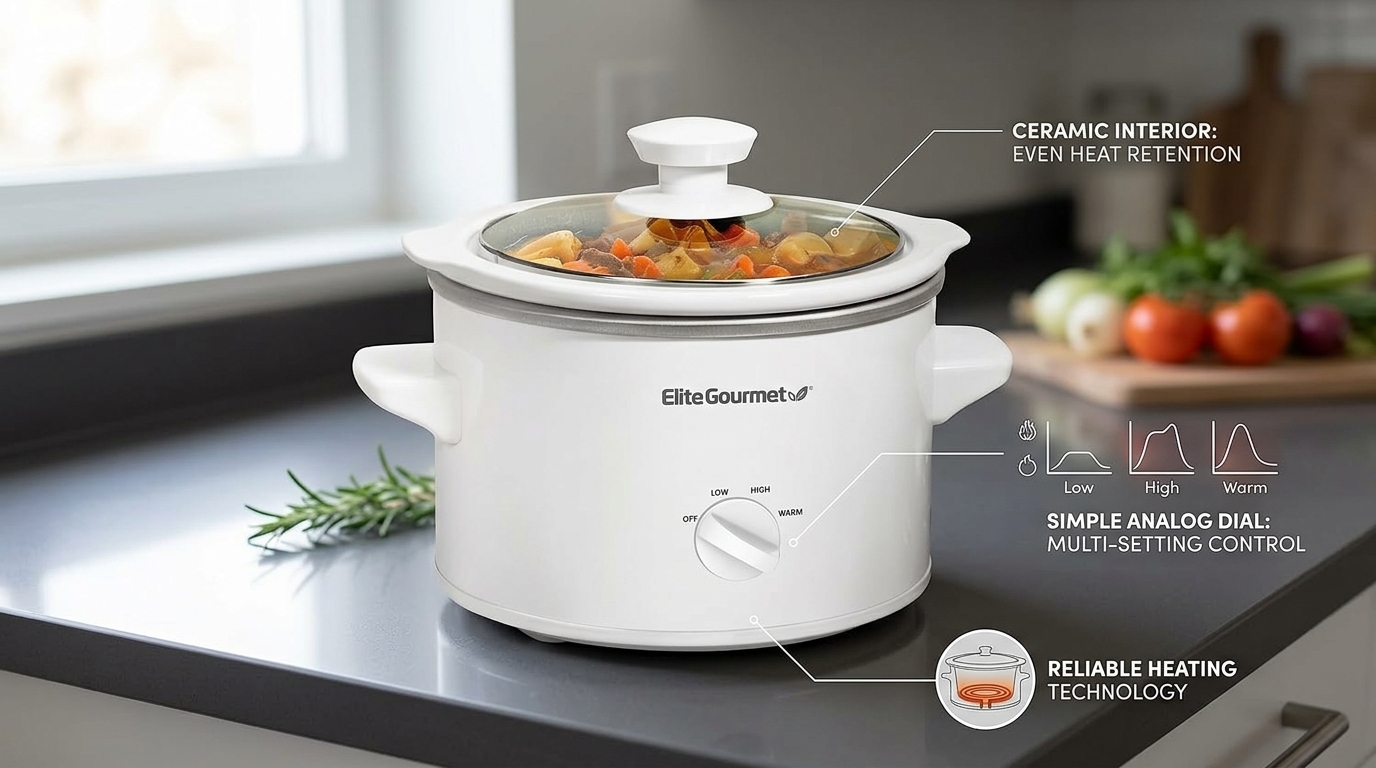
That’s the general category the Elite Gourmet MST-250XW Electric Ceramic Slow Cooker fits into. It’s a compact, 1.5-quart countertop appliance with a removable ceramic (stoneware) pot, a tempered glass lid, and an adjustable dial that lets you choose between Low, High, and Keep Warm settings. It comes in a white finish with a rounded, simple design meant to take up minimal counter space.
This article walks through what the MST-250XW is designed to do, how people commonly use small-format slow cookers like this one, who tends to find them useful, and a few practical points worth thinking through before adding one to your kitchen. The goal here isn’t to tell you it’s the “best” anything — it’s to give you a clear, balanced picture so you can decide whether a compact ceramic slow cooker fits your actual cooking habits.
Key Features
Before getting into use cases, it helps to understand what this particular model includes and how its components are put together. Here’s a rundown of the main features associated with the Elite Gourmet MST-250XW:
1.5-Quart Ceramic Pot At the center of the appliance is a removable stoneware (ceramic) insert with roughly 1.5 quarts of capacity. That’s a relatively small volume compared to standard slow cookers, which typically range from 3 to 8 quarts. The oval shape is meant to accommodate small cuts of meat, like a couple of chicken thighs or a modest roast, in addition to soups, dips, and sauces.
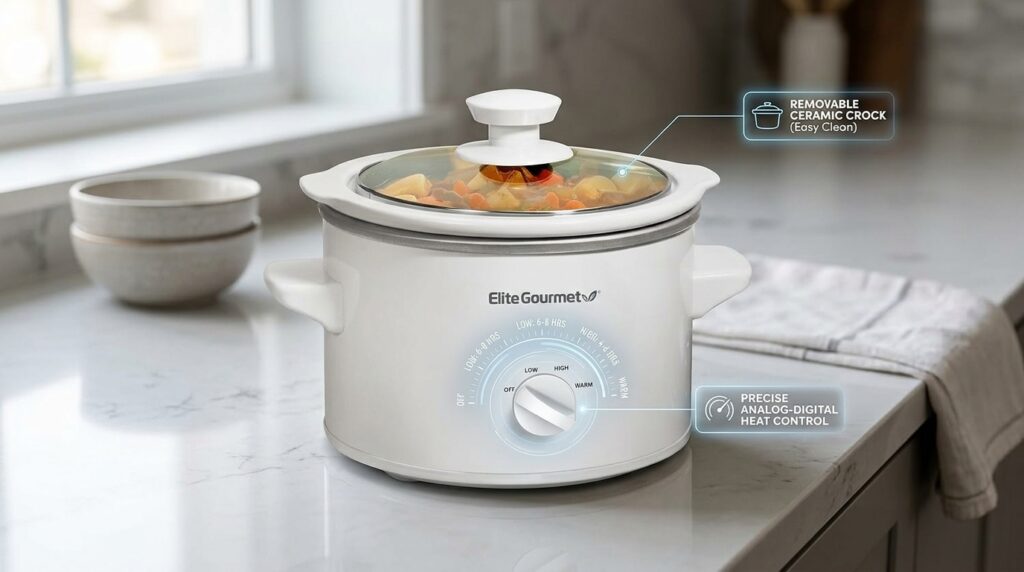
Adjustable Temperature Dial Rather than a digital touchscreen or programmable timer, this model uses a manual dial with three settings: Low, High, and Keep Warm. Low and High govern the actual cooking temperature, while Keep Warm is intended to hold already-cooked food at a safe serving temperature without continuing to cook it further. This kind of analog control is common in entry-level and compact slow cookers, and it keeps the interface simple — there’s no clock to set or programming sequence to learn.
Tempered Glass Lid with Metal Rim The lid is made of tempered glass, which allows you to check on food as it cooks without lifting the lid and releasing heat and moisture. A metal rim reinforces the edge of the glass. Because the lid is a separate, removable piece, it can go in the dishwasher along with the stoneware pot.
Cool-Touch Handles and Knob The exterior handles and the control knob are designed to stay cooler to the touch than the ceramic pot itself, which is a common safety feature in slow cookers meant to make it easier to move or adjust the unit mid-cook without needing oven mitts. That said, “cool-touch” doesn’t mean cold — caution around any actively heating appliance is still warranted.
Dishwasher-Safe Components The stoneware pot and glass lid are both listed as dishwasher-safe, which simplifies cleanup after use. The electric heating base, which houses the wiring and heating element, is not submersible and should be wiped down with a damp cloth instead.
Compact, Lightweight Footprint Weighing only a few pounds and measuring roughly 9 inches in depth, the unit is built to be easy to store in a cabinet or leave out on a counter without dominating the space. This also makes it relatively easy to transport — for instance, bringing it to a potluck or a relative’s house for a holiday gathering.
120-Watt Power Draw The appliance runs on standard household current and draws 120 watts, which is modest compared to larger slow cookers or other kitchen appliances like toaster ovens or air fryers. This is generally reflected in a small footprint and lower energy use during operation, since it’s heating a much smaller volume of food.
Safety Listing and Warranty The unit is listed with recognized safety certification (from independent testing labs such as UL or Intertek, depending on the production run) and is backed by a one-year limited warranty through Elite Gourmet’s parent company, Maxi-Matic. Warranty terms and customer support processes can change over time, so it’s worth checking current documentation from the manufacturer or the product listing for specifics.
How It Can Be Used
A 1.5-quart slow cooker isn’t going to replace a large one for holiday-sized batches of stew, but it opens up a specific set of everyday and occasional uses that a bigger appliance often isn’t well suited for.
Single-serving or two-person meals. This is probably the most straightforward use case. Because the pot is small, it’s easier to portion ingredients for one or two people without ending up with a week’s worth of leftovers you didn’t plan for. Dishes like a small pot of chicken and rice, a modest beef stew, or a lentil soup can be built around a 1.5-quart capacity without much math.
Dips and party appetizers. Small slow cookers are frequently used to keep dips — queso, spinach-artichoke dip, buffalo chicken dip, or barbecue meatballs — warm throughout a gathering. The Keep Warm setting is particularly relevant here, since it’s designed to hold food at serving temperature for an extended period without it drying out, scorching, or overcooking on the bottom.
Sauces and reductions. Because the appliance heats gently and consistently at low temperatures, it can be used for things like marinara, barbecue sauce, or a small batch of applesauce, where slow, even heat helps flavors meld without the risk of scorching that comes with stovetop cooking if you step away.
Warm beverages for small gatherings. Some people use compact slow cookers for mulled wine, cider, or hot chocolate for a small group, since the Keep Warm function can hold a beverage at a pleasant serving temperature for a few hours.
Overnight or all-day cooking for one. For people who work long hours, starting a small dish in the morning on Low and coming home to a finished meal is a common way people use compact slow cookers generally. Because the volume is small, cook times for many recipes tend to run shorter than what you’d see in a full-size slow cooker recipe, so if you’re adapting a recipe written for a bigger unit, some adjustment is usually needed.
Secondary cooker during holidays or hosting. Even households that already own a full-size slow cooker sometimes add a small one specifically to manage a side dish, a sauce, or a warm appetizer table without needing a second large pot to babysit.
Limited kitchen or non-traditional living spaces. Dorm rooms, small studio apartments, RVs, and offices with a shared kitchenette are all environments where a compact appliance with a lower wattage draw and small footprint tends to be more practical than a full-size cooking setup.
Who It May Be Suitable For
Given the capacity and control style, certain households and cooking habits tend to line up well with this kind of appliance, while others may find it limiting. It’s worth being honest about both sides.
People who may find it useful:
- Individuals living alone who want to cook proper hot meals without generating excessive leftovers
- Couples who cook modest portions and don’t need multi-day batch quantities
- College students or people in dorm-style housing with limited kitchen equipment and outlet access
- Hosts who want a dedicated, low-maintenance appliance for keeping a dip, sauce, or beverage warm during a party
- People downsizing from a larger household (empty nesters, for example) who no longer need large-format cookware
- Anyone looking for a lower-wattage alternative to running an oven or stovetop for small quantities of food
- People who prefer simple manual dials over programmable digital interfaces
People who may want to consider a larger or different appliance:
- Larger families or households that regularly cook meals for four or more people
- Anyone who relies on slow cooking specifically to batch-cook and freeze meals in bulk
- Cooks who want programmable start times, digital timers, or automatic shutoff features tied to a countdown clock
- People planning to slow-cook whole roasts, full chickens, or large cuts of meat that wouldn’t physically fit in a 1.5-quart pot
This isn’t a judgment on the appliance itself — it’s simply a matter of matching capacity and features to the way a given household actually cooks.
Important Things to Consider
No appliance is a perfect fit for every kitchen, and it’s worth thinking through a few practical details before deciding whether this style of slow cooker matches your needs.
Capacity is genuinely small. At 1.5 quarts, this is meant for individual or small-batch cooking. If you’re used to standard slow cooker recipes written for 4- to 6-quart models, those quantities and cook times generally won’t translate directly — you’ll usually need to scale ingredient amounts down and keep a closer eye on cook time the first few times you use it, since smaller volumes of food often cook faster than larger ones.
Manual control, not programmable. The Low/High/Keep Warm dial is straightforward, but it doesn’t include a built-in timer that automatically switches the unit to Keep Warm after a set number of hours, which some higher-end or larger slow cookers offer. That means if you’re leaving the house for an extended period, you’re relying on your own planning around cook time rather than an automated cutoff — a detail that matters more for some safety-conscious users than others.
The base isn’t submersible. While the stoneware pot and glass lid are dishwasher-safe, the electric base housing the heating element and cord should only be wiped down, not soaked or submerged. This is standard for virtually all electric slow cookers, but it’s worth keeping in mind for cleanup routines.
Cord length and outlet placement. As with most compact countertop appliances, the cord length is limited, so it’s worth checking where you intend to place and use the unit relative to available outlets, especially if you plan to move it around the kitchen or bring it to a different location for gatherings.
Ceramic construction and handling care. The stoneware pot, like most ceramic cookware, can be prone to cracking if subjected to sudden temperature changes — for instance, placing a hot pot directly under cold water. General care instructions for ceramic slow cooker inserts typically apply here as well.
Not intended as a substitute for pressure cooking or rapid cooking. Slow cookers, including compact ones, are built around gradual, low-temperature cooking. If you’re looking for a faster cooking method, a slow cooker of any size generally isn’t the right category of appliance regardless of wattage or capacity.
Warranty and support details can change. Coverage terms, registration processes, and customer support channels are set by the manufacturer and may be updated over time. It’s a good idea to review current warranty documentation directly from Elite Gourmet or Maxi-Matic rather than relying solely on older product materials.
Comparison of General Slow Cooker Categories
Rather than comparing this specific model against other named products, it can be more useful to understand where compact slow cookers sit relative to the broader categories of slow cookers on the market. Here’s a general breakdown:
Mini/Personal Slow Cookers (roughly 0.5 to 2 quarts) This category, which includes the MST-250XW, is designed around individual servings, dips, sauces, and small side dishes. The tradeoff for the smaller footprint and lower energy use is limited capacity — these units aren’t intended for cooking large cuts of meat or feeding a full household in one batch.
Mid-Size Slow Cookers (roughly 3 to 4.5 quarts) This range tends to suit two- to four-person households and is often the category recipe books default to when a specific size isn’t mentioned. Mid-size units strike a balance between counter space and cooking capacity, and many include both manual dials and basic digital timer functions.
Large/Family-Size Slow Cookers (roughly 6 to 8+ quarts) Designed for larger households, meal prepping in bulk, or cooking whole roasts and poultry, these units take up considerably more storage and counter space and draw more power during operation. They’re generally the better fit for anyone who wants to freeze leftovers in bulk or host large gatherings regularly.
Manual Dial vs. Digital Programmable Controls Separate from size, slow cookers also vary by control type. Manual dial models (like this one) tend to be simpler, often more affordable, and easier to operate without instructions, but they typically lack automatic timers or delayed-start functions. Digital programmable models allow you to set specific cook durations and often switch automatically to a warming mode, which can suit people who are away from home for unpredictable stretches of time, though these models tend to have a steeper learning curve and, at times, more components that could require troubleshooting.
Ceramic/Stoneware Inserts vs. Metal Inserts Most traditional slow cookers use a removable ceramic or stoneware insert, which tends to distribute heat evenly and doubles as a serving dish. Some compact and travel-oriented slow cookers use metal inserts instead, which are typically lighter and more resistant to chipping or cracking but may not retain heat as evenly. The MST-250XW falls into the ceramic insert category, which is the more traditional and widely used approach for this style of appliance.
Viewed through this lens, the MST-250XW sits squarely in the mini/personal, manual-dial, ceramic-insert category — a specific and fairly well-defined niche rather than a general-purpose slow cooker meant to compete with larger family units.
Frequently Asked Questions
Is the Elite Gourmet MST-250XW big enough for a whole chicken? No. At 1.5 quarts, the pot is sized for small cuts of meat, individual portions, dips, or sauces rather than a whole bird or a large roast. For that, a mid-size or family-size slow cooker would be a better fit.
Can I leave it unattended all day like a larger slow cooker? Many people do use slow cookers, including compact ones, for extended unattended cooking, but because this model lacks a programmable auto-shutoff timer, it relies on manual monitoring of cook time rather than an automated cutoff. If unattended cooking safety is a priority for your household, it’s worth weighing that against models with built-in timers.
What’s the difference between the Low, High, and Keep Warm settings? Low and High refer to two different cooking temperatures, generally used depending on how much time you have and what you’re cooking — High cooks faster, Low cooks more gradually over a longer period. Keep Warm is meant for after cooking is finished, to hold already-cooked food at a safe serving temperature without continuing to actively cook it.
Is the pot removable, and can it go in the dishwasher? Yes, the stoneware pot and the tempered glass lid are both designed to be removable and are listed as dishwasher-safe. The electric base itself should not be submerged in water and should instead be wiped down with a damp cloth.
Does it come with a recipe book? Documentation and included materials can vary by retailer and over time, so it’s worth checking the current product listing or manufacturer resources for what’s included with a specific unit. Many manufacturers also publish recipes on their own websites.
What’s the wattage, and does it use a lot of electricity? It operates at 120 watts, which is relatively low compared to many kitchen appliances, in part because it’s heating a small volume of food. Actual energy use over a cooking session will still depend on cook time and setting.
Is it suitable for cooking for a family of four? It’s generally better suited to individual servings, two-person meals, or side dishes rather than a full family meal, given its 1.5-quart capacity. Households cooking for more than two people on a regular basis may find a mid-size or larger slow cooker more practical.
How long is the warranty, and who do I contact for support? The product is generally backed by a one-year limited warranty through Maxi-Matic (the parent company of the Elite Gourmet brand), though it’s a good idea to confirm current terms and support contact details directly through the manufacturer, since policies can be updated.
Conclusion
The Elite Gourmet MST-250XW is a fairly clear example of a purpose-built appliance: a compact, ceramic-pot slow cooker designed around small portions, simple manual controls, and easy cleanup, rather than an attempt to compete with full-size family slow cookers. For someone cooking for one or two people, hosting a small gathering and needing a dedicated dip warmer, or living in a space where counter room and outlet access are limited, that kind of focused design can be genuinely practical. For larger households or anyone planning to batch-cook and freeze meals, a bigger capacity unit — possibly with programmable digital controls — would likely be a better match for those specific needs.