Introduction
Slow cooking has held a steady place in home kitchens for decades, and its appeal hasn’t faded even as cooking trends have shifted toward faster methods like air frying and pressure cooking. There’s something reassuring about being able to load a pot with ingredients in the morning and come home to a meal that’s already done. But not every household needs — or has room for — a large, family-sized slow cooker. For people cooking for one or two, or for anyone whose kitchen counter space is already at a premium, a compact slow cooker can be a more practical fit.
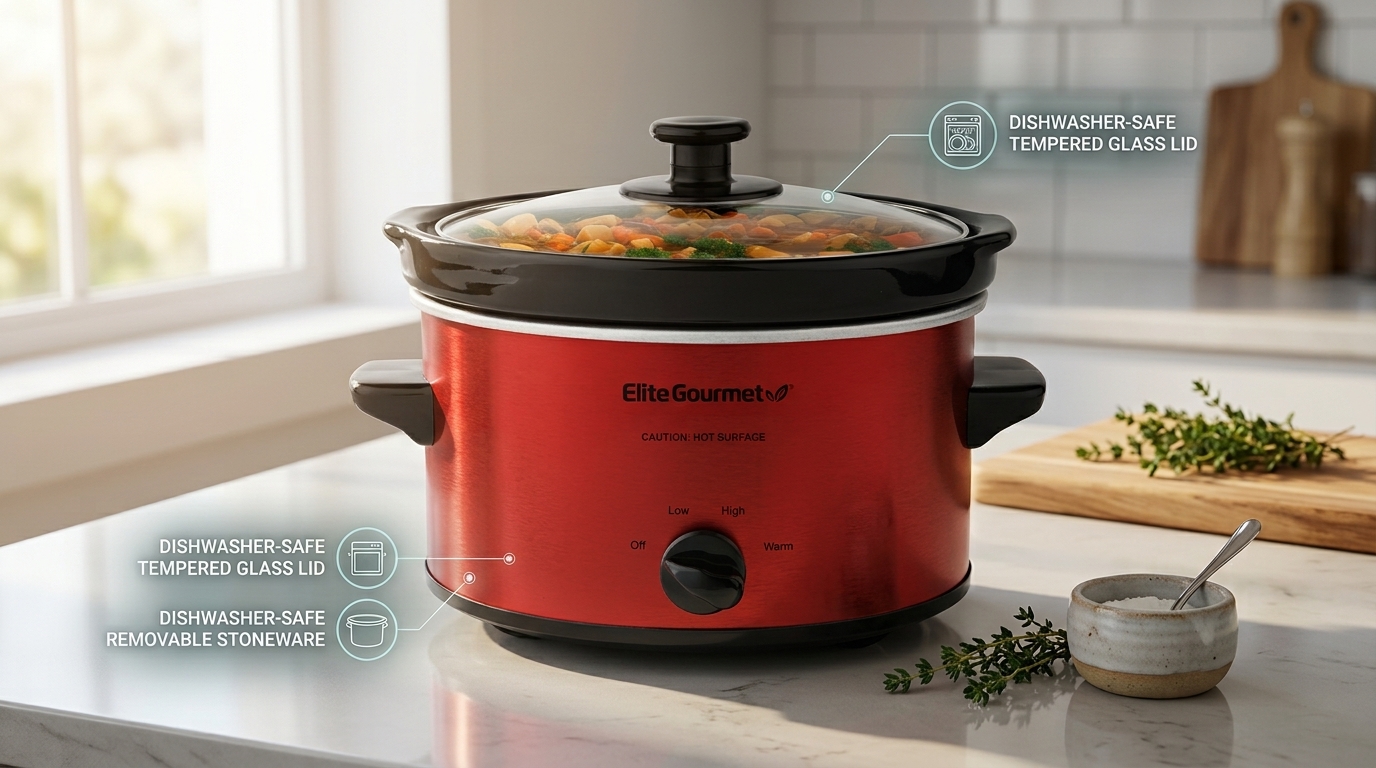
The Elite Gourmet MST-275XR is a 2-quart oval slow cooker finished in metallic red. It’s built around the same basic idea as larger slow cookers — a heated base, a removable stoneware crock, and a lid that traps moisture and heat — but scaled down to suit smaller portions and smaller kitchens. This article walks through what the appliance offers, how it might fit into different cooking routines, and what’s worth thinking about before deciding whether it matches your needs. The goal here isn’t to declare it the right choice for everyone, but to lay out the practical details so you can weigh them against your own cooking habits.
Key Features
2-Quart Oval Capacity At 2 quarts, this slow cooker sits on the smaller end of the spectrum. The oval shape of the crock is worth noting specifically, since it’s designed to accommodate elongated cuts of meat or poultry pieces more naturally than a round crock of the same volume would. That shape choice matters more than it might seem — an oval interior tends to make better use of available space when you’re cooking something like a small roast or bone-in chicken thighs rather than a purely liquid-based dish.
Removable Stoneware Crock The inner pot lifts out of the heating base, which is a fairly standard design across slow cookers but still worth mentioning because it affects both cooking flexibility and cleanup. Being able to remove the crock means you can bring it straight to the table for serving, or set it aside to cool before washing, without having to deal with the electrical base at all.
Dishwasher-Safe Glass Lid and Crock Both the tempered glass lid and the stoneware crock are described as dishwasher-safe, which can be a meaningful convenience factor for people who don’t want to hand-wash cookware after every use. The glass lid also has a practical cooking benefit on its own: it allows you to check on food as it cooks without lifting the lid, which helps avoid unnecessary heat loss and keeps cooking times more consistent.
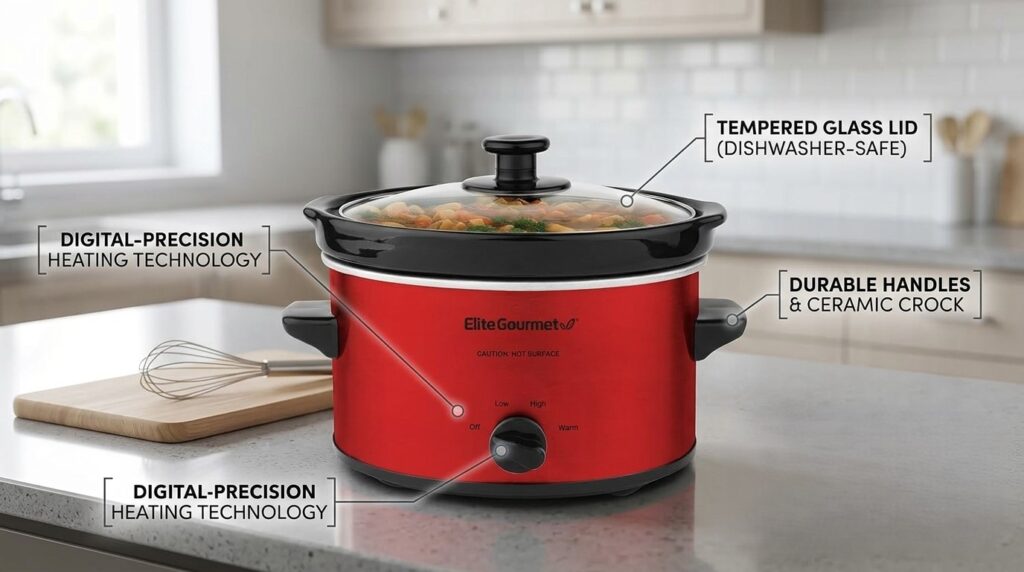
Cool-Touch Handles and Knob The handles on the crock and the control knob are designed to stay cooler to the touch than the surrounding surfaces during operation. This kind of detail is common in slow cooker design because these appliances are often left running for hours, and at some point someone needs to move or serve from a pot that’s been heating for a long stretch.
Adjustable Temperature Settings The MST-275XR offers Low, High, and Keep Warm settings, controlled manually via a dial rather than a digital interface. Manufacturer materials also reference a defrost-adjacent low-heat setting suited to gentler cooking. This is a straightforward, no-frills control setup — there’s no programmable timer or app connectivity, just a physical dial you turn to the setting you want.
Power Indicator Light A built-in indicator light shows when the unit is actively powered on, which is a small but useful safety and convenience feature, particularly if the appliance is tucked into a corner of the counter where it’s not always in direct line of sight.
Compact, Countertop-Friendly Design Because of its smaller footprint compared to standard 4- to 8-quart slow cookers, this model is easier to store in a cabinet or leave out on a counter without dominating the space — a relevant consideration for smaller kitchens, apartments, or shared living situations.
How It Can Be Used
A 2-quart oval slow cooker isn’t meant to replace a full-size model for holiday dinners or large batch cooking, but it does open up a fairly wide range of everyday uses, particularly for smaller households.
Entrees for One or Two The oval shape is well suited to smaller cuts of meat and poultry — manufacturer information points to portions in the range of about two pounds, such as a small chicken or a modest roast. This makes it a reasonable option for weeknight dinners scaled to a smaller household rather than a family gathering.
Soups, Stews, and Chilis in Smaller Batches For soups and stews, the smaller capacity actually works in your favor if you’re not looking to eat the same dish for a week straight. You can portion ingredients for two to three servings without ending up with a refrigerator full of leftovers you didn’t plan for.
Sauces and Simmered Dishes The product is specifically positioned around sauces as well as entrees, which makes sense given the Low and Keep Warm settings. Simmering a marinara sauce, a chili base, or a slow-cooked barbecue sauce over several hours can develop flavor in a way that’s harder to replicate on a stovetop, where you’d need to monitor and stir more frequently.
Dips for Small Gatherings The Keep Warm setting lends itself naturally to dips — cheese-based dips, chili con queso, or warm bean dips can be prepared ahead of time and then held at a steady serving temperature for a few hours during a get-together, without someone needing to reheat it repeatedly on the stove.
Side Dishes Smaller side dishes like mashed potatoes, baked beans, or a rice-based side can be prepared in the crock while the oven or stovetop is occupied with a main dish, which can be a genuinely useful bit of extra capacity during a multi-dish meal.
Meal Prep and Portion Control For people trying to manage portion sizes deliberately — whether for dietary reasons or simply to avoid excess leftovers — a smaller slow cooker naturally limits how much food gets made in a single batch, which can be a helpful built-in constraint rather than a drawback.
Compact Living Situations Dorm rooms, small apartments, RVs, and offices with a shared kitchenette are all settings where a full-size slow cooker would be impractical but a compact one could still get regular use, provided there’s a nearby outlet and enough counter space for the unit itself.
Who It May Be Suitable For
Given its size and feature set, this slow cooker tends to align well with a specific set of circumstances rather than being a universal fit.
- People living alone who want the convenience of slow cooking without ending up with several days’ worth of the same leftovers.
- Couples cooking primarily for two, where a full-size crock would routinely be underfilled.
- College students or dorm residents who have limited kitchen access and need a compact, easy-to-clean appliance.
- RV owners or frequent travelers who want slow-cooking capability without the bulk of a larger unit.
- Households that already own a large slow cooker and want a smaller secondary appliance specifically for sauces, dips, or side dishes during larger meals.
- Anyone with limited kitchen storage, such as renters in smaller apartments, where a bulky appliance would be difficult to store between uses.
- People who prefer simple, manual controls over digital programming and don’t need delayed-start or automatic shut-off features.
On the other hand, this likely isn’t the right fit for larger families, anyone doing regular batch cooking for freezer meals, or households that frequently host large group dinners requiring a big roast or whole bird. In those cases, a larger-capacity slow cooker would be more practical.
Important Things to Consider
No appliance is a perfect match for every kitchen, and it’s worth thinking through a few practical points before deciding if this size and style of slow cooker fits your routine.
Capacity Is Genuinely Limited Two quarts is a small volume by slow cooker standards. It’s easy to underestimate just how much smaller this is compared to the 6-quart models that dominate most kitchen appliance sections. If you regularly cook for three or more people, or if you like having leftovers for multiple days, this capacity may feel restrictive fairly quickly.
Manual Controls Mean No Programming Because the temperature settings are controlled by a physical dial rather than a digital timer, there’s no option to set a specific cook time and walk away with an automatic shift to Keep Warm at the end. Depending on the specific unit’s design, this may mean paying closer attention to cooking duration than you would with a programmable model — it’s worth checking the included instructions for guidance on how long different settings are meant to run and whether unattended operation is recommended.
Stoneware Care Ceramic and stoneware inserts, while sturdy for everyday cooking, are more prone to cracking from sudden temperature changes than metal inserts. General best practice with stoneware crocks is to avoid moving a cold crock directly into a hot base, or vice versa, and to let it cool gradually rather than exposing it to cold water while still hot. The included manual should have specific care instructions worth following closely.
Dishwasher Safety Details Can Vary While the crock and glass lid are described as dishwasher-safe, it’s worth checking whether that applies to all dishwasher cycles or just certain settings, since some manufacturers recommend top-rack placement or gentler cycles for ceramic and glass cookware to reduce wear over time.
Countertop and Storage Space Even a compact appliance still needs a permanent or semi-permanent spot on the counter or in a cabinet. If your kitchen is already tight on storage, it’s worth measuring the space you have available before assuming “compact” will automatically solve a storage problem.
Cord Length and Placement Small appliances sometimes come with shorter cords than their larger counterparts, and outlet placement in a kitchen isn’t always convenient. It’s a minor point, but one that occasionally trips people up after a purchase.
Comparison of General Categories
Rather than comparing this specific model against named competitors, it’s more useful to look at the broader categories of slow cookers it belongs to, since that context can help clarify where it fits.
Compact (1–3 Quart) vs. Standard (4–8 Quart) Slow Cookers Compact slow cookers are generally built for individuals, couples, or supplementary use alongside a larger cooker, while standard-sized units are designed around family meals or batch cooking. The trade-off is fairly intuitive: smaller units take up less space and produce smaller portions, while larger ones offer more flexibility for big meals but demand more storage room and counter space.
Manual Dial Controls vs. Programmable Digital Controls Manual slow cookers, like this one, rely on a simple dial to select Low, High, or Keep Warm, and require the user to manually switch settings or turn the unit off. Programmable models add a digital timer and often an automatic shift to a “warm” setting once cooking time elapses. Manual models tend to be simpler and often more affordable, while programmable ones offer more hands-off convenience for people who are away from home for long stretches during the cooking process.
Oval vs. Round Crock Shapes Oval crocks are generally better suited to elongated cuts of meat, such as roasts or whole poultry pieces, since the shape mirrors the natural form of those cuts more closely. Round crocks tend to be favored for soups, stews, and liquid-heavy dishes where shape is less of a factor. Neither shape is objectively better — it largely comes down to what you cook most often.
Stoneware Inserts vs. Nonstick Metal Inserts Stoneware crocks, like the one included here, are prized for even heat retention and are generally dishwasher-safe, but they’re heavier and more fragile than metal alternatives. Nonstick metal inserts are typically lighter and more resistant to chipping or cracking, though they may not retain heat quite as evenly and can be more prone to scratching over time if metal utensils are used.
Understanding where a given slow cooker sits across these categories can make it easier to judge whether its design matches your cooking style, independent of any specific brand.
Frequently Asked Questions
Can this slow cooker be left unattended while cooking? This depends on the specific guidance in the included instruction manual. Many slow cookers, including compact manual models, are designed with low-heat settings intended for extended cooking, but it’s always worth reviewing the manufacturer’s recommendations on unattended use and following standard kitchen safety practices, such as keeping the appliance on a stable, heat-safe surface away from flammable materials.
What size of meat or poultry realistically fits inside a 2-quart crock? Manufacturer materials reference portions around two pounds, such as a small whole chicken or a modest roast, given the compact oval shape of the interior. Bulkier cuts or larger poultry would likely need to be trimmed or portioned to fit properly.
Is the stoneware crock microwave-safe? Stoneware and ceramic slow cooker inserts are not universally microwave-safe, and this can vary by manufacturer. It’s best to check the specific care and use instructions included with the unit rather than assuming compatibility.
Can it be used to keep dips or sauces warm during a gathering? Yes — the Keep Warm setting is specifically intended for holding prepared food, such as dips or sauces, at a steady serving temperature over an extended period without continuing to actively cook or reduce the dish.
Does it include a timer or programmable cook settings? No. Based on available product information, this model uses manual dial controls for Low, High, and Keep Warm settings rather than a digital timer or programmable interface.
How should it be cleaned after use? The stoneware crock and tempered glass lid are described as dishwasher-safe, making cleanup relatively straightforward. The heating base, however, contains electrical components and should never be submerged in water — it’s generally best wiped down with a damp cloth once fully cooled and unplugged.
Is it a good option for meal prepping in bulk? Given the 2-quart capacity, this isn’t the most efficient choice for large-batch meal prep intended to last a full week or to be frozen in bulk. It’s better suited to smaller, more immediate portions.
Conclusion
The Elite Gourmet MST-275XR occupies a fairly specific niche within the broader world of slow cookers: a compact, oval, 2-quart unit aimed at smaller households, simpler cooking routines, and situations where a full-size appliance would be more than what’s needed. Its dishwasher-safe stoneware crock and glass lid, cool-touch handles, and straightforward Low/High/Keep Warm dial controls make it a fairly uncomplicated appliance to use day to day, while its compact size and metallic red finish give it a distinct look on a smaller kitchen counter.
Whether it’s the right choice ultimately comes down to how much food you typically need to prepare and how much value you place on simple, manual controls versus programmable features. For someone cooking mainly for one or two people, or looking for a secondary cooker dedicated to sauces and dips, it’s a reasonable option to weigh against similarly sized alternatives. For larger households or bulk cooking needs, a larger-capacity slow cooker would likely serve better.