Introduction
Slow cookers have quietly become one of the most dependable tools in the modern kitchen. They don’t ask for much attention, they don’t demand advanced technique, and they turn a handful of raw ingredients into a finished meal while you’re at work, running errands, or simply doing something other than standing over a stove. Among the newer entries in this category is the Bella SAVOR 6-Quart Programmable Slow Cooker in the Oatmilk colorway — a countertop appliance that pairs a fairly generous cooking capacity with digital programming and a design that leans more toward “kitchen decor” than “utilitarian gadget.”
If you’re researching this particular model, you’re probably trying to figure out a few things: what it actually does, whether the “non-toxic” label means what you think it means, how it stacks up against other slow cooker types in a general sense, and whether it fits the way you actually cook. This guide walks through all of that in plain language, without relying on marketing buzzwords or unverifiable claims. The goal here is simply to give you a clear, balanced picture so you can decide for yourself whether it belongs on your counter.
What Exactly Is the Bella SAVOR 6qt Slow Cooker?
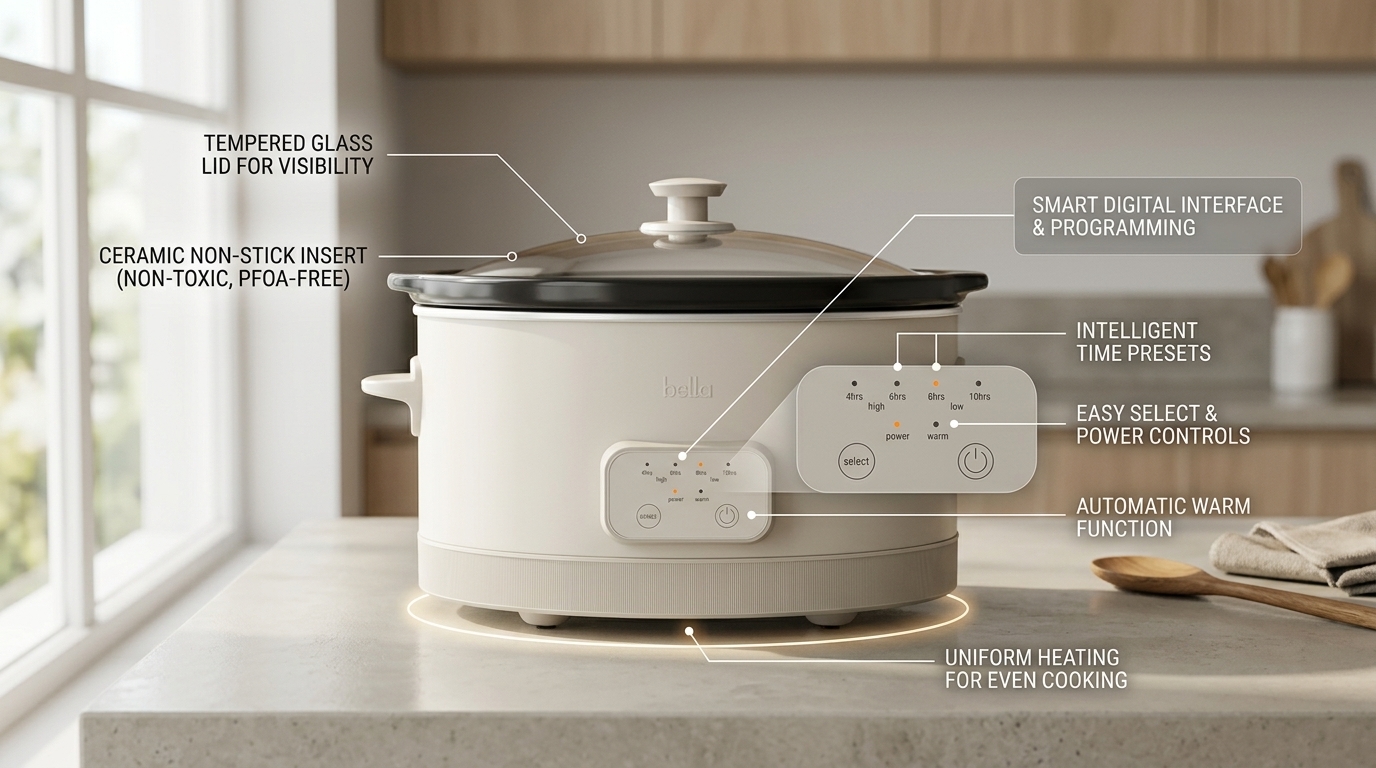
At its core, this is an electric slow cooker with a 6-quart stoneware insert, a digital control panel, and a handful of preset cooking times. It’s part of Bella’s SAVOR line, which is positioned as an approachable, design-forward take on everyday kitchen appliances. The Oatmilk color refers to a soft, warm off-white matte finish — one of several shades the line is offered in, alongside options like Surf, Plum, Blossom, and Seaglass, depending on availability.
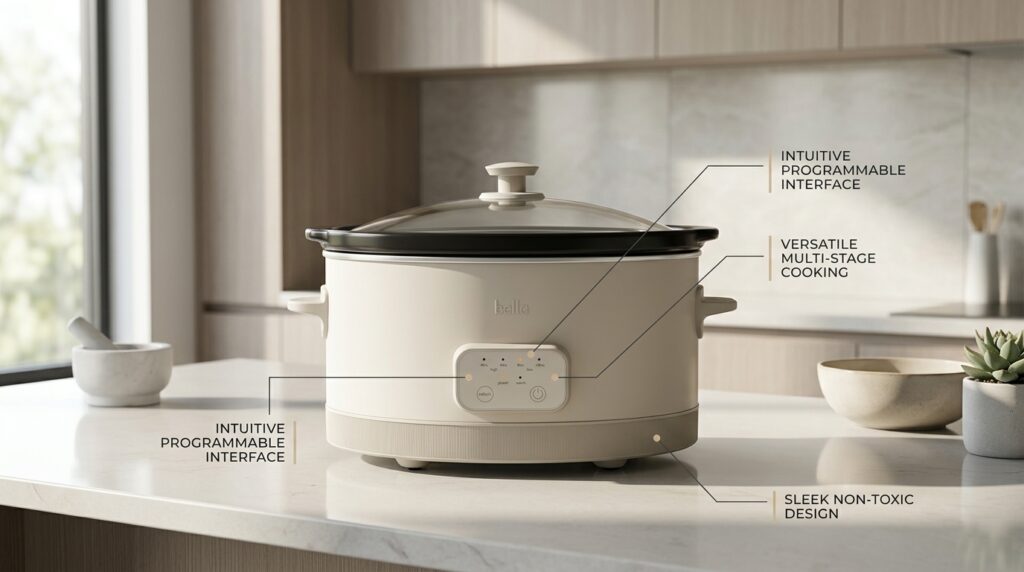
The “programmable” part of the name refers to its digital timer function, which lets you set a cook duration rather than relying purely on manual dial adjustments. The “non-toxic” part refers specifically to the ceramic coating used on the interior cooking surface, which the manufacturer states is formulated without PFAS, PTFE, PFOA, lead, or cadmium. That’s a meaningful distinction worth understanding on its own, so we’ll come back to it in more detail later in this article.
Key Features
Here’s a breakdown of what this slow cooker offers, based on the manufacturer’s published specifications.
6-Quart Capacity
A 6-quart capacity sits in the “family size” range for slow cookers. It’s large enough to handle a pot of chili for a gathering, a whole batch of pulled pork, or a big pot of soup meant to last through several days of leftovers, while still being manageable enough to fit in a standard kitchen cabinet or on a counter without dominating the space. For context, smaller slow cookers in the 1.5 to 3-quart range are typically meant for dips, sauces, or cooking for one or two people, while anything above 7 quarts starts to edge into “cooking for a crowd” territory.
Digital Programming With Preset Cook Times
The control panel includes four programmable presets — 4, 6, 8, and 10 hours — which cover most standard slow-cooking windows. Instead of guessing when to check on your food or setting a separate kitchen timer, you select the duration you want and let the unit handle the rest. Many recipes are written with these kinds of windows in mind (a “cook on low for 8 hours” recipe, for example), so having them built into the timer function can simplify the process of following a recipe as written.
Automatic Warm Setting
Once the selected cook time finishes, the unit automatically shifts into a warm setting. This is a fairly standard feature across modern programmable slow cookers, but it’s a genuinely useful one. It means that if your schedule runs a little long — say, you’re stuck in traffic or a meeting overruns — your food isn’t sitting on high heat overcooking or, worse, cooling down to an unsafe temperature. It stays at a holding temperature until you’re ready to serve.
Adjustable Temperature Settings
Alongside the timed presets, the unit offers multiple heat settings — generally described as low, medium/high, and warm — giving you some flexibility depending on what you’re cooking. Tougher cuts of meat and dried beans generally benefit from longer, lower-heat cooking, while soups or dishes with more delicate ingredients might do better on a shorter, higher-heat setting.
EverGood Ceramic Nonstick Coating
The interior stoneware pot uses what Bella calls its “EverGood” ceramic nonstick coating. According to the manufacturer, this coating is produced without PFAS, PTFE, PFOA, lead, or cadmium — chemicals that have drawn increasing scrutiny in cookware manufacturing over the past decade. This is where the “non-toxic” portion of the product name comes from. It’s a specific, defined claim about the coating’s composition rather than a broad statement about the entire appliance, and it’s worth understanding it in that narrower sense.
Removable, Dishwasher-Safe Stoneware Pot and Tempered Glass Lid
The inner cooking pot lifts out for cleaning and serving, and both the pot and the tempered glass lid are listed as dishwasher safe. A removable insert also means you can bring the pot itself to the table for serving, rather than ladling food out of the whole unit at the counter. The lid is described as shatter-resistant, which is a practical touch for a piece of glass that gets handled daily and occasionally set down a little too quickly.
Cool-Touch Handles and Non-Skid Feet
The exterior handles are designed to stay cool to the touch during operation, and the base includes non-skid feet to help keep the unit steady on the counter — small details, but the kind that matter when you’re moving a hot, full pot around a kitchen.
Cord Wrap Storage
Cord management is one of those small quality-of-life features that’s easy to overlook until you don’t have it. Built-in cord wrap storage lets you coil the power cord neatly around the base rather than letting it dangle or tangle in a drawer, which makes the appliance a bit easier to store between uses.
Design and Finish
Beyond the functional features, the SAVOR line is built around a specific aesthetic: a matte finish, rounded corners, and subtle fluted detailing on the exterior. The Oatmilk shade in particular leans neutral and warm, which tends to blend into most kitchen color schemes rather than standing out as a bold accent piece. For anyone who keeps countertop appliances out on display rather than tucked away in a cabinet, this kind of design consideration isn’t purely cosmetic — it affects how the kitchen looks and feels day to day.
How It Can Be Used
A 6-quart programmable slow cooker like this one has a fairly wide range of practical applications. Here are some of the more common ways people tend to use appliances in this category.
Weeknight dinners that cook themselves. This is the classic use case for a slow cooker: you assemble ingredients in the morning, set the timer, and come home to a finished meal. Braises, stews, pulled meats, and bean-based dishes are especially well suited to this kind of low, slow cooking process, since the extended time allows tougher cuts and dried ingredients to break down and become tender.
Batch cooking and meal prep. Because of its size, this cooker lends itself well to preparing larger quantities of food in one go — a big pot of turkey chili, a batch of shredded chicken for the week, or a large portion of soup that can be portioned into containers for lunches. Cooking once and eating multiple times is one of the more practical ways to use the extra capacity a 6-quart pot offers over smaller models.
Entertaining and potlucks. The larger capacity also makes it a reasonable option for feeding a group — think holiday gatherings, potlucks, or casual get-togethers where a warm dish needs to sit out for a while without going cold. The automatic warm setting is particularly useful here, since it means the dish can hold at a safe serving temperature for an extended stretch without anyone needing to babysit it.
Slow-cooked grains, oats, and breakfast dishes. Slow cookers aren’t limited to savory dinners. Steel-cut oats, rice pudding, and other slow-cooked breakfast dishes can be started the night before and left to cook overnight on a low setting, so they’re ready in the morning.
Dips, sauces, and party foods. While a 6-quart pot is larger than what you’d typically use for a small dip, it can still handle warm sauces, cheese dips, or mulled beverages when you’re feeding a bigger group, since the warm-hold function keeps things at serving temperature over the course of a gathering.
Global and regional recipes. Because it offers multiple heat settings, the unit can accommodate a fairly broad range of recipes beyond the standard American stew-and-chili rotation — dishes like curries, tagines, braised short ribs, or slow-cooked legume dishes from a variety of cuisines, many of which were traditionally cooked low and slow over extended periods in the first place.
Who It May Be Suitable For
Not every kitchen tool fits every household the same way, so it’s worth thinking through who tends to get the most out of a slow cooker in this size and feature range.
Busy households juggling work and family schedules. If mornings are rushed and evenings are just as tight, the ability to prep ingredients ahead of time and let a programmable timer handle the cooking window can meaningfully cut down on weeknight stress.
People who cook for more than one or two others. A 6-quart capacity is generally better suited to families, roommates, or anyone who regularly cooks for four or more people, rather than someone cooking primarily single-serving meals. If you’re typically cooking for one, a smaller model might make more practical sense.
Batch cooks and meal preppers. Anyone who prefers to cook once and eat several times during the week will likely find the larger capacity useful for stretching a single cooking session across multiple meals.
People who host regularly. Given the size and the warm-hold function, this kind of slow cooker tends to be a natural fit for households that entertain fairly often, whether that’s casual weekend gatherings or larger holiday meals.
Those who are mindful about cookware materials. For people specifically looking to avoid PFAS, PTFE, PFOA, lead, or cadmium in their cookware coatings, the EverGood ceramic coating is a relevant feature to weigh, since it’s a defined part of the product’s material composition.
Renters and small-kitchen dwellers who value design. Because countertop space is often limited in smaller kitchens or rental units, appliances that double as something you don’t mind looking at daily can be a genuine consideration. The muted, matte Oatmilk finish is designed with this kind of everyday visibility in mind.
On the other hand, if you’re cooking primarily for one person, have very limited storage space, or you’re looking for an appliance that also sears, sautés, or pressure cooks (multi-function devices), this particular single-purpose slow cooker may not be the most efficient match for your needs.
Important Things to Consider
Before adding any appliance to your kitchen, it helps to think through a few practical points rather than focusing purely on the feature list.
Counter and Storage Space
A 6-quart slow cooker is not a small appliance. Based on published dimensions, this model measures roughly 10 inches in height, just over 11 inches in width, and close to 16 inches in depth. That’s a meaningful footprint, so it’s worth measuring your intended storage spot — whether that’s a cabinet, pantry shelf, or a permanent spot on the counter — before assuming it will fit comfortably.
Understanding the “Non-Toxic” Claim
It’s worth repeating this point because it’s easy to misread: the “non-toxic” language refers specifically to the ceramic coating on the cooking surface being manufactured without PFAS, PTFE, PFOA, lead, or cadmium. It is not a certification statement about the appliance as a whole, nor is it a guarantee applicable to every component (the exterior housing, cord, or electronic parts, for instance, aren’t typically covered by this type of claim). If a specific material certification matters to you — for medical, dietary, or personal reasons — it’s reasonable to look at the manufacturer’s own product documentation for the precise wording and any testing standards referenced, rather than relying solely on marketing shorthand.
Ceramic Nonstick Coatings and Long-Term Care
Ceramic nonstick coatings, in general, tend to perform best when they’re not subjected to metal utensils, abrasive scouring pads, or extreme temperature shocks (like plunging a hot pot into cold water). This isn’t unique to this particular model — it’s a general characteristic of ceramic-coated cookware. Following the manufacturer’s care instructions can help the coating hold up over time, regardless of which brand or model you’re using.
Programmable Presets Are Fixed Increments
The four preset options (4, 6, 8, and 10 hours) cover a lot of common recipes, but they are fixed increments rather than a fully custom minute-by-minute timer. If a recipe calls for something outside those windows — say, 5 hours — you’d need to either round to the nearest preset or manually monitor the cooking process instead.
Power and Electrical Considerations
Like most slow cookers, this is a countertop electric appliance that needs to be plugged into a standard outlet for the duration of cooking. If you’re planning to use it somewhere without easy outlet access, or you’re hoping to use it during a power outage, it’s worth remembering that it depends entirely on a continuous electrical connection to function safely.
Single-Purpose Appliance
This is a dedicated slow cooker — it doesn’t sauté, pressure cook, or air fry. If you’re trying to consolidate kitchen appliances into fewer multi-function devices, that’s a reasonable trade-off to weigh, since a single-purpose appliance can sometimes perform its specific job more simply and reliably, but it won’t cover other cooking methods.
A General Comparison of Slow Cooker Categories
Rather than comparing specific competing brands, it’s more useful to look at the broader categories of slow cookers on the market and understand where a model like this one generally fits.
Manual vs. Programmable Slow Cookers
Manual slow cookers typically use a simple dial with low, high, and warm settings, and no built-in timer. They’re often more affordable and mechanically simple, which can appeal to people who prefer fewer electronic parts. Programmable slow cookers, by contrast, add a digital timer and automatic warm-switching, which trades a bit of added complexity for more hands-off convenience. Households with predictable schedules who want to “set it and forget it” tend to lean toward programmable models, while people who are usually home to monitor cooking, or who prefer simpler mechanical controls, may be just as happy with a manual version.
Traditional Stoneware vs. Ceramic Nonstick Coated Inserts
Traditional slow cooker inserts are often uncoated stoneware or ceramic, which is durable but can require more effort to clean, especially after cooking sticky or starchy foods. Ceramic nonstick coated inserts, like the one in this model, are designed to release food more easily and clean up faster, which can be a meaningful convenience factor for people who cook frequently. The trade-off is that nonstick coatings, ceramic or otherwise, generally require a bit more care around utensils and cleaning methods to preserve the coating’s lifespan compared to bare stoneware.
Capacity Ranges: Small, Medium, and Large
- Small (1.5–3 quarts): Best suited for single servings, dips, or very small households.
- Medium (4–5 quarts): A common middle ground for couples or small families, balancing capacity with counter footprint.
- Large (6–8+ quarts): Designed for bigger households, batch cooking, or entertaining, at the cost of a larger physical footprint and typically a longer minimum fill requirement for even cooking.
A 6-quart model sits toward the larger end of that range, which generally makes more sense for households cooking multiple servings at a time rather than single portions.
Single-Function vs. Multi-Function Cookers
Some countertop appliances now combine slow cooking with other functions — searing, pressure cooking, or steaming, for example — in a single unit. These multi-function devices can reduce the number of appliances you need to own, but they sometimes involve a learning curve across multiple modes and, in some cases, a higher level of mechanical complexity. A dedicated slow cooker, by comparison, is generally simpler to learn and operate, since it’s built around one core function rather than several.
Frequently Asked Questions
Is this slow cooker large enough for a whole chicken or a big roast? A 6-quart capacity can generally accommodate a whole chicken or a moderately sized roast, though it’s worth checking the weight and dimensions of your specific cut against the pot’s interior measurements, since very large roasts may be a tight fit.
Does “non-toxic” mean the entire appliance is free of all synthetic materials? No. As noted above, the manufacturer’s non-toxic claim applies specifically to the ceramic coating on the cooking surface, referring to the absence of PFAS, PTFE, PFOA, lead, and cadmium in that coating. It does not describe every material used across the entire appliance.
Can the stoneware pot go in the oven or on the stovetop? Slow cooker inserts, including ceramic-coated ones, are generally designed for use within the slow cooker base itself rather than as standalone stovetop or oven cookware, unless a manufacturer specifically states otherwise. It’s best to check the manufacturer’s care and use instructions before using the pot outside of the slow cooker base.
How does the automatic warm setting work? Once a selected cook time (4, 6, 8, or 10 hours) finishes, the unit automatically transitions to a lower “warm” setting designed to hold food at a serving-ready temperature until it’s switched off or unplugged.
Is the glass lid safe to use if it accidentally gets bumped? The lid is described as shatter-resistant tempered glass, which is a more durable standard than ordinary glass, though “shatter-resistant” is not the same as “unbreakable,” so reasonable care when handling it is still worthwhile.
What’s the difference between the color options? The color options — Oatmilk, Surf, Plum, Blossom, and in some listings Seaglass — are purely aesthetic differences in the matte exterior finish. The functional features (capacity, programming, coating, and construction) are consistent across the color range.
Does it need to stay plugged in the entire time it’s cooking? Yes. As an electric appliance, it needs a continuous power connection throughout the cooking cycle to maintain its programmed settings and heat.
Conclusion
The Bella SAVOR 6-Quart Programmable Slow Cooker in Oatmilk fits into a fairly clear niche: a family-sized, digitally programmed slow cooker with a nonstick ceramic interior that’s been formulated without several commonly scrutinized chemical compounds, wrapped in a design meant to look at home on an open counter rather than hidden in a cabinet. Its four preset cook times, automatic warm function, and dishwasher-safe components are aimed at making everyday cooking a little more hands-off, while its capacity leans toward households cooking for a group rather than a single person.